
 Fast, Free and No Risk


Bond of Qualifying Individual (BQI): Requirements, Cost, and CSLB Filing Guide (2026)
 Updated for 2026 Licensing Requirements
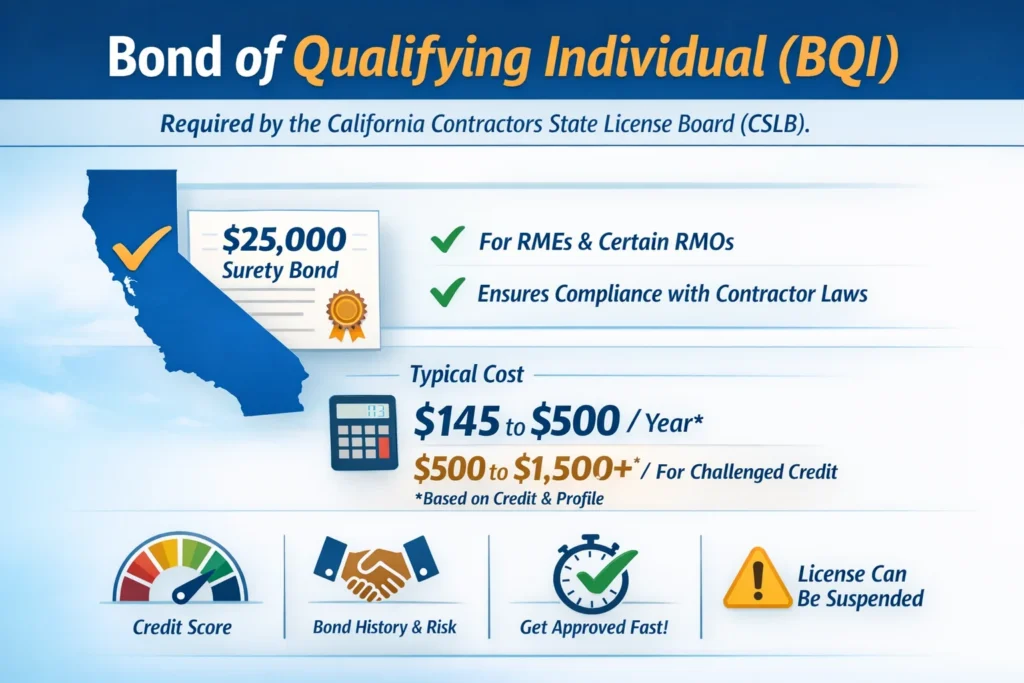
The Bond of Qualifying Individual (BQI) is a $25,000 surety bond required by the California Contractors State License Board (CSLB) when a contractor license is qualified by a Responsible Managing Employee (RME) or, in some cases, a Responsible Managing Officer (RMO) who does not meet the applicable ownership requirement under California law.
This bond helps protect the public by guaranteeing compliance with California contractor licensing laws and the qualifier’s legal responsibilities under the California Business and Professions Code.
Many qualified applicants pay about $145 to $225 per year, but actual pricing varies based on credit, bond history, underwriting factors, and the qualifier’s profile.
Get Your BQI Bond Quote in Minutes →
California Bond of Qualifying Individual (BQI) – Key Facts
Key facts about the California Bond of Qualifying Individual required by the CSLB:
- Required Bond Amount: $25,000
- Required By: California Contractors State License Board (CSLB)
- Typical Cost: $145 to $225 per year for many applicants with strong credit
- Average Cost Range: $145 to $500 per year depending on credit profile, qualifier role, and license history
- Higher Risk Cost Range: $500 to $1,500+ for challenged credit, prior bond claims, bankruptcy, or higher underwriting risk
- Cost Basis: Credit-based underwriting — you do not pay $25,000
- What Affects Cost: Credit score, bond history, financial strength, claims, qualifier relationship to the business, and license record
- Who May Need It: Contractors using an RME or certain RMOs as the qualifier, depending on ownership structure and CSLB requirements
- Approval Time: Most BQI bonds can be approved quickly online
- Payment Options: Premium financing may be available for higher-cost bonds
- Renewal: Bond is continuous until canceled and typically renews annually
- Filing Method: Surety company electronically files the bond with the CSLB when permitted
- Purpose: Helps ensure the qualifying individual fulfills duties under California contractor licensing requirements
What Is a California Bond of Qualifying Individual?
A Bond of Qualifying Individual guarantees that the designated qualifier will properly supervise and control the construction operations of the licensed business.
The bond helps support compliance with:
- The California Business and Professions Code
- CSLB rules and regulations
- Lawful supervision of licensed construction activities
The BQI helps protect consumers and others who may be financially harmed if the qualifying individual fails to fulfill legal responsibilities under California contractor licensing law.
How Much Does a BQI Bond Cost?
| Credit Profile | Estimated Annual Premium | Typical Applicant Profile |
|---|---|---|
| Good Credit | $145 to $225 per year | Strong credit history, no prior bond claims, stable profile, experienced contractor, and lower underwriting risk. |
| Average Credit | $225 to $500 per year | Moderate credit with some financial issues, limited derogatory history, or a thinner credit profile. |
| Lower Credit | $500 to $1,500+ per year | Credit challenges, prior bond claims, bankruptcy, or higher underwriting risk. Financing may be available. |
Although the required bond amount is $25,000, contractors do not pay $25,000 upfront. Instead, they pay a smaller annual premium to the surety company.
Pricing is primarily based on:
- The personal credit of the RME or RMO
- Licensing and work history
- Bond history and prior claims
- Overall underwriting risk
Many qualified applicants fall within a range of about $145 to $500 per year, while applicants with lower credit may pay more.
Applicants With Lower Credit
Applicants with challenged credit may:
- Pay higher premiums
- Be required to provide more underwriting information
- Be declined by some surety companies
Some sureties use a soft credit inquiry during quoting, but underwriting methods vary by carrier.
When Is a Bond of Qualifying Individual Required?
Under California Business and Professions Code section 7071.9, a Bond of Qualifying Individual is required in certain licensing situations involving a qualifying individual.
In general, a BQI bond may be required when:
- A contractor license is qualified by an RME, or
- A contractor license is qualified by an RMO who does not meet the required ownership threshold
A Bond of Qualifying Individual (BQI) is required when a license is qualified by a Responsible Managing Officer (RMO) who owns less than 10% of the corporation’s voting stock. If the RMO owns 10% or more, they are not required to carry the bond but must instead complete and submit a Bond of Qualifying Individual Exemption Certification. Federally recognized tribes and participating tribes are exempt from the BQI requirement.
If multiple Responsible Managing Employees (RMEs) or RMOs are listed as qualifiers on a license, each individual must independently meet the applicable bonding requirements.
Because licensing structure matters, contractors should verify the exact requirement with the CSLB when setting up or changing a qualifier.
Additional CSLB Requirements for RMEs
- Must be a bona fide employee
- Must work at least 32 hours per week or 80 percent of the business’s operating hours, whichever is less
- Cannot qualify another active contractor license unless specifically allowed by CSLB rules
If the license is not being qualified in a way that triggers section 7071.9, a BQI bond is not required.
What Is the Bond Amount?
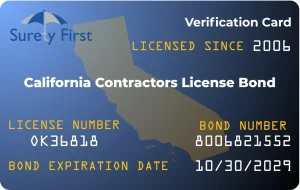
The required BQI bond amount is $25,000.
This bond is separate from:
- The $25,000 California Contractor License Bond
- The $100,000 LLC Employee/Worker Bond required for certain LLC contractors
Each bond serves a different legal purpose.
Bond of Qualifying Individual (BQI) vs Contractor License Bond
| Feature | Bond of Qualifying Individual | Contractor License Bond |
|---|---|---|
| Required Amount | $25,000 | $25,000 |
| Required By | CSLB (California Contractors State License Board) | CSLB (California Contractors State License Board) |
| Who Needs It | Contractors using an RME or certain RMOs who do not meet ownership requirements | All licensed California contractors |
| Purpose | Ensures the qualifier properly supervises and complies with contractor laws | Protects the public from contractor violations, non-payment, and misconduct |
| Based On | Credit of the RME or RMO (qualifying individual) | Credit of the business owner(s) |
| Typical Cost | $145 – $500/year (higher for challenged credit) | $145 – $500/year (higher for challenged credit) |
| Required for License | Only in specific qualifier situations | Always required to obtain and maintain a contractor license |
| Filed With | CSLB (often electronically by surety) | CSLB (often electronically by surety) |
| What Happens If Missing | License can be suspended if required and not filed | License cannot be issued or will be suspended |
| Transferability | Tied to specific qualifier (RME/RMO) | Tied to licensed business entity |
Responsibilities of an RME vs. RMO
Responsible Managing Officer (RMO)
- Holds an official officer position within the corporation or LLC
- May qualify a corporation or LLC
- May own anywhere from 0 percent to 100 percent of the company, depending on structure
Responsible Managing Employee (RME)
- Is listed as an employee rather than an owner-officer
- Must be on payroll
- May require workers’ compensation treatment depending on the business setup
- May qualify certain entity types subject to CSLB rules
Both RMEs and RMOs must demonstrate sufficient trade experience and be accepted by the CSLB as the qualifier.
Can an RME or RMO Be Substituted for Underwriting?
No.
- Another individual’s credit cannot be substituted for the actual qualifier
- The business entity’s credit does not replace the qualifier’s credit for a BQI bond
- The bond must be based on the actual RME or RMO listed on the CSLB license
Because underwriting is based heavily on the qualifier’s profile, bonding costs may increase if that qualifier has weaker credit or higher risk factors.
Contractors should think carefully about licensing structure before naming a qualifier.
What Happens If the RME or RMO Leaves?
If a qualifier leaves the company:
- A dissociation request generally must be filed with the CSLB within the required time period
- The filing must be signed by authorized personnel on record
Failure to timely notify the CSLB can lead to problems such as:
- License suspension
- Removal of classifications
- Retroactive record adjustments
Under California licensing rules, the qualifier may remain responsible for work performed before the official dissociation date recorded by the CSLB.
How to Obtain a California Bond of Qualifying Individual

- Apply online by clicking “Get Quote” and get an instant online quote in minutes
- Confirm quote
- Sign the application
- The surety electronically files your bond with the CSLB
When quoting through other brokers be sure to verify the BQI details:
- Be issued by a surety company licensed in California
- Be written in the amount of $25,000
- Match the exact business name and license information on file with the CSLB
- Include the qualifier’s name exactly as listed with the CSLB
- Be signed by the surety’s attorney-in-fact when required
- Be submitted in the proper CSLB-approved form and filing method
Filing timing matters. Contractors should make sure the bond is filed promptly so the license does not become delayed, suspended, or rejected for an incomplete record.
Common Mistakes with California Bond of Qualifying Individual (BQI)
Many contractors misunderstand how BQI bonds work. These mistakes can delay licensing, increase costs, or lead to suspension.
- Assuming the BQI replaces the contractor license bond
A BQI bond is separate from the $25,000 contractor license bond. If required, you must carry both. - Using the wrong qualifier’s credit
The BQI bond is based on the actual RME or RMO listed on the license. You cannot use the business owner’s credit or another individual’s credit to qualify. - Not realizing a BQI is required
Many contractors don’t know a BQI bond is required when using an RME or certain RMOs without sufficient ownership. This can delay license approval. - Incorrect business or qualifier name on the bond
The bond must match the CSLB license exactly, including business name, license number, and qualifier name. Errors can cause rejection. - Waiting too long to file the bond
Bonds must be filed within CSLB deadlines. Late filing can result in license suspension or delays in activation. - Assuming all RMOs require a BQI bond
Not all RMOs require a BQI. Ownership percentage and structure matter. This is frequently misunderstood. - Letting the bond cancel or lapse
If a required BQI bond is canceled and not replaced, the CSLB can suspend your contractor license. - Thinking the bond protects the contractor
The BQI bond protects the public. If a claim is paid, the contractor and indemnitors are responsible for repayment. - Choosing the wrong licensing structure
Selecting an RME or low-ownership RMO without understanding the BQI requirement can increase costs and complexity.
Get a Fast BQI Bond Quote
Surety First specializes in:
- California Contractor License Bonds
- Bond of Qualifying Individual (BQI)
- LLC Employee or Worker Bonds
- General Liability Insurance
- Performance Bonds
- Fast electronic CSLB filings where permitted
Many bonds can be approved quickly, often within minutes.
Get Your BQI Bond Quote Now →
California Bond of Qualifying Individual (BQI) – FAQ
What is a California Bond of Qualifying Individual (BQI)?
A Bond of Qualifying Individual (BQI) is a $25,000 surety bond required by the California Contractors State License Board in certain situations when a contractor license is qualified by an RME or by an RMO who does not meet the applicable ownership requirement.
Who needs a BQI bond in California?
A BQI bond is commonly required when a contractor license is qualified by an RME or by a qualifying officer who does not meet the required ownership threshold. Contractors should verify their exact filing requirement with the CSLB.
What is the required BQI bond amount?
The required Bond of Qualifying Individual amount in California is $25,000.
How much does a BQI bond cost?
Most contractors do not pay the full bond amount. Instead, they pay an annual premium that often ranges from about $145 to $500 for qualified applicants, with higher rates for lower-credit applicants.
Is the BQI bond required in addition to the contractor license bond?
Yes. When required, the BQI bond is separate from the California Contractor License Bond.
What does a BQI bond protect?
The bond helps protect consumers and others who may suffer financial harm if the contractor or qualifier violates California contractor licensing laws.
Does the BQI bond protect the contractor?
No. The bond protects the public. If the surety pays a valid claim, the contractor and indemnitors may be required to repay the surety.
How long does it take to get a BQI bond?
Many BQI bonds can be quoted and issued quickly, sometimes the same day, depending on underwriting.
What happens if the BQI bond is canceled?
If a required BQI bond is canceled and not replaced, the contractor license can be suspended by the CSLB.
Can a BQI bond be transferred to another qualifier?
No. A BQI bond is tied to the specific qualifying individual and must be updated if the qualifier changes.
What law requires the BQI bond?
The BQI requirement is governed by California Business and Professions Code section 7071.9.
Reviewed by: Jeremy Schaedler
Principal – Surety First Insurance Services
As principal at Surety First, Jeremy Schaedler has specialized in contractor license bonds and construction insurance since 2006. CA License: 0F06277
This information is for general informational purposes only and does not constitute legal advice. Licensing and bond requirements can change. Contractors should verify current requirements directly with the California Contractors State License Board or consult qualified legal counsel.

Management team at Surety First Insurance Services, specializing in contractor license bonds and commercial insurance for contractors.
Why Contractors Choose Surety First
Surety First Insurance Services has specialized in contractor bonds and construction insurance since 2006. Our agency focuses on the needs of licensed contractors, helping professionals obtain contractor license bonds, bid bonds, performance bonds, payment bonds, and liability insurance quickly and reliably.
Our network of A-rated surety companies approves many bonds quickly. We also electronically file contractor license bonds with the appropriate licensing board when permitted. Our team understands the licensing and bonding requirements contractors face and works to make the process simple, fast, and accurate.
Contractors across California, Oregon, Washington, Nevada, and Arizona rely on Surety First for straightforward advice, competitive pricing, and responsive service.
Phone: 1-800-682-1552
Website: suretyfirst.com
Sources
California Contractors State License Board (CSLB)
California Business and Professions Code section 7071.9
California Senate Bill 607 (SB 607)