 Fast, Free and No Risk



Contractor General Liability Insurance: Cost, Coverage & Requirements (2026 Guide)
 Updated for 2026 Licensing Requirements
Quick Answer: Contractors face liability risk on nearly every job. A customer can trip over tools, a worker can damage a client’s property, or a dispute over advertising can turn into a claim. General liability insurance helps protect contractors and construction businesses from third-party claims involving bodily injury, property damage, and personal or advertising injury. It can also help pay legal defense costs, settlements, and judgments, up to policy limits.
Because construction work involves job-site hazards, equipment, and client property, general liability insurance is one of the most important business insurance policies a contractor can carry. In many cases, clients, landlords, or project owners require proof of coverage before work begins.
Contractor General Liability Insurance – Key Facts
- Typical Coverage Limits: $1,000,000 per occurrence / $2,000,000 aggregate
- Typical Cost: $500 – $3,500/year for many small contractors
- Who Needs It: General contractors, electricians, plumbers, HVAC contractors, roofers, landscapers, painters, carpenters, and nearly all other construction professionals
- States Covered: California, Oregon, Washington, Nevada, and Arizona
- Proof of Coverage: Certificate of Insurance (COI) required by clients, landlords, and project owners
- Purpose: Protects against third-party bodily injury, property damage, and personal or advertising injury claims
Download the Contractors GL Guide (Free PDF)
State Licensing Requirements (General Liability)
- Oregon: Required for licensing through the Construction Contractors Board (CCB)
- Washington: Required for contractor registration through Labor & Industries (L&I)
- California: Not required for most licenses, but commonly required by contracts; required for LLC contractors
- Arizona: Not typically required for licensing, but commonly required by project contracts
- Nevada: Not universally required as a standalone GL requirement for every contractor license. Required in some instances.
▶ View Transcript
[00:00] If you’re a contractor, one accident on a job site can cost you thousands of dollars.
[00:04] General liability insurance protects your business from third-party claims involving property damage and bodily injury.
[00:08] Whether a client trips over equipment or your crew accidentally damages property, this policy covers your costs.
[00:13] Construction carries risk every day. A small mistake can quickly turn into a serious financial problem.
[00:20] Most project owners require proof of general liability insurance before allowing any work to begin.
[00:25] And remember, general liability insurance is not the same as a contractor license bond. A bond protects the public.
[00:31] Insurance protects your business and your bottom line.
[00:33] If you’re unsure about your coverage, speak with an insurance specialist at Surety First.
[00:39] We help you get the right protection without overpaying.
[00:41] Get your fast quote.
Contractor General Liability Insurance Requirements by State
| State | Authority | Is GL Required for Licensing? | Minimum Requirement | Notes |
|---|---|---|---|---|
| California | California Contractors State License Board (CSLB) | Generally no for most license types; yes for LLC contractor licenses. | LLC contractors must carry at least $1 million in liability insurance for five or fewer personnel of record, with additional coverage required for more personnel. | Most non-LLC contractors are not subject to a universal CSLB GL minimum, but contracts commonly require $1M / $2M limits. |
| Oregon | Oregon Construction Contractors Board (CCB) | Yes. | Minimum coverage varies by license endorsement. | Oregon law requires contractors to carry general liability insurance. Contractors must maintain coverage based on their CCB license endorsement. |
| Washington | Washington Department of Labor & Industries (L&I) | Yes. | $200,000 public liability and $50,000 property damage, or $250,000 combined single limit. | L&I must be listed as the certificate holder, and the insurance must match the contractor’s exact business name. |
| Nevada | Nevada State Contractors Board (NSCB) | Not universally required as a standalone GL requirement for every contractor license. | No universal statewide GL minimum stated for all contractors. Contractors must maintain required bond coverage and workers’ compensation compliance unless exempt. | Nevada requires licensed contractors to maintain a bond and establish financial responsibility. GL insurance is commonly required by contracts, owners, landlords, and commercial projects. |
| Arizona | Arizona Registrar of Contractors (ROC) | Typically no statewide GL requirement for licensing. | No universal statewide GL minimum for contractor licensing. | Arizona contractors must generally carry the required contractor license bond. GL insurance is still commonly required by project contracts and commercial clients. |
Additional State Licensing Notes:
- Oregon and Washington require liability insurance as part of contractor licensing.
- California, Nevada, and Arizona typically do not have a blanket general liability insurance requirement for licensing, but there are exceptions. Always check with each state license board for up to date requirements. General liability is widely required by project contracts, landlords, and general contractors.
- Most contractors carry policies with $1M / $2M limits to meet typical commercial contract requirements even though some state mandated requirements may be lower.
Contractor general liability requirements vary by state—some require coverage to get licensed, while others make it a de facto requirement through contracts. Use the guides below to understand what applies to your business.
- Oregon CCB Liability Insurance Requirements: Limits by Residential vs. Commercial License
- Washington L&I Liability Insurance Compliance: The $250k Combined Single Limit Policy
- Multi-State Contracting: How to Add “Other States” Endorsements to Your GL Policy
- Arizona ROC Contractor Insurance: What You Need for Your License
- California LLC Employee/Worker Bond Requirements & The $1M Liability Insurance Mandate
- Nevada Contractor Insurance: Limits for Residential vs. Commercial
What Does General Liability Insurance Cover?
Contractor general liability insurance typically protects against three main types of third-party claims:
- Bodily injury (job-site accidents involving clients, visitors, or the public)
- Property damage (damage to a client’s property caused by your work or operations)
- Personal and advertising injury (claims like libel, slander, or advertising-related issues)
- Products and completed operations (commonly included coverage- can respond when a completed job later causes bodily injury or property damage.)
- Medical payments (sometimes included coverage for small third-party injury claims, subject to policy terms and limits.)
This chart breaks down the core protections included in most contractor general liability policies and why each one matters for your business.
| Coverage / Requirement | What It Means for Contractors | Why It Matters |
|---|---|---|
| Bodily Injury | Covers third-party injury claims, such as a client or visitor getting hurt at a job site. | Helps pay medical costs, legal defense, settlements, or judgments. |
| Property Damage | Covers accidental damage to someone else’s property caused by your work or operations. | Protects against repair costs and related liability claims. |
| Personal & Advertising Injury | Covers certain non-physical claims, such as libel, slander, or advertising-related issues. | Helps protect against claims tied to marketing or business communications. |
| Products and Completed Ops. | General liability policies commonly include products-completed operations protection. | If a completed job later causes bodily injury or property damage. |
| Medical Payments | This feature can sometimes resolve minor incidents quickly without a lawsuit. | Sometimes included coverage for small third-party injury claims, subject to policy terms and limits. |
These coverages are designed to handle medical costs, repairs, legal defense, and settlements when you’re held liable. For full details, common coverages and exclusions, see: Complete Guide to Contractor GL Coverage & Common Exclusions
Why General Liability Insurance Matters for Contractors
Construction businesses work in environments where claims can happen quickly. Contractors use tools, ladders, scaffolding, vehicles, and materials around customers, subcontractors, and the public. As a result, even a minor incident can create a costly liability claim. General liability insurance helps contractors protect cash flow, preserve business stability, and meet contract requirements.
This coverage is especially important for contractors who:
- Work on client property
- Meet customers at an office or home office
- Lease shop, office, or warehouse space
- Bid commercial or public jobs
- Hire employees or subcontractors
- Advertise online or in print
Contractor GL Claims: A Real-World Example
A homeowner visiting an active job site tripped over tools left in the work area and suffered an injury. The contractor was held responsible for unsafe conditions.
The contractor’s general liability policy covered:
-
- Medical expenses
- Legal defense
- Settlement costs
These types of third-party injury claims—along with property damage and job-site accidents—are among the most common reasons contractors carry general liability insurance. For a full breakdown of how claims are handled, see: How Does a General Liability Insurance Claim Work for Contractors?
Who Benefits From General Liability Insurance?
Most contractors benefit from general liability protection, but the coverage is especially important for trades that regularly work in active job-site conditions or on customer property.
Common examples include:
- General contractors
- Electricians
- Plumbers
- Roofers
- HVAC contractors
- Landscapers
- Painters
- Carpenters
Also, contractors face liability exposure in different business settings. Examples include:
Contractors in the Field
Field contractors face the greatest day-to-day exposure to bodily injury and property damage claims. Active job sites create many opportunities for accidents, especially when tools, equipment, and third parties share the same space. General liability insurance helps protect the business when those incidents lead to claims.
Home-Based Contractor Businesses
Some contractors operate from a home office and meet clients there. In those cases, general liability insurance may help if a visitor gets injured during a business-related visit. It can also help with certain personal and advertising injury claims tied to marketing or business communications.
Small Businesses With Physical Locations
If your contracting business rents an office, storefront, or warehouse, visitors can get hurt on the premises. Landlords and commercial property managers often require proof of liability insurance before leasing space. A certificate of insurance helps show that the policy is active and lists key coverage details.
How Much Does Contractor General Liability Insurance Cost?
Contractor general liability insurance costs vary based on risk, but most contractors fall within these general ranges:
- Low risk trades: ~$40–$80/month
- Moderate risk: ~$80–$150/month
- Higher risk: ~$150–$300+/month
Most policies are written with $1M / $2M limits, which are commonly required by project owners and general contractors. Your actual cost depends on factors like trade, payroll, subcontractor use, and overall risk exposure. For a detailed breakdown of pricing factors and real scenarios, see: Contractor GL Cost Guide: How Payroll, Sub-Costs, and Trade Impact Your Rate
Premium Audits
Some general liability policies are subject to audit. At the end of the policy period, the insurer may compare your estimated payroll, subcontractor costs, or business activity with your actual numbers. If your estimates were too low or too high, the insurer may adjust the premium. What you pay upfront isn’t always your final premium—many contractor policies are audited and adjusted after the policy period ends. Contractor Insurance Audits: How to Avoid a Massive “End-of-Year” Bill
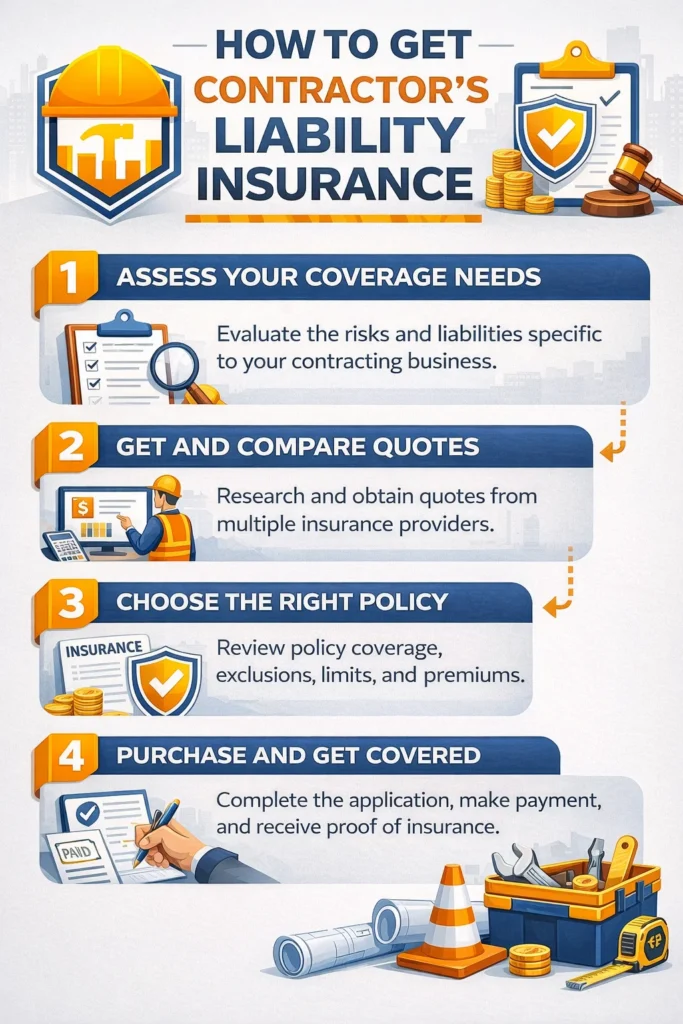
How to Get Contractor General Liability Insurance
Step 1: Assess Your Coverage Needs
Start by evaluating the risks associated with your construction business. Consider the type of work you perform, the number of employees you have, and whether you work on residential or commercial projects. Contractors should also review contract requirements, since many project owners require minimum liability limits such as $1 million per occurrence and $2 million aggregate.
Understanding your risk exposure helps determine the appropriate coverage limits and policy features needed for your business.
Choosing the right policy starts with understanding how much coverage you actually need—based on your risk, contracts, and scope of work. How Much General Liability Insurance Do Contractors Really Need?
General Liability vs Contractor License Bond
General liability insurance protects your business by covering lawsuits, injuries, and property damage claims.
A contractor license bond protects the public and guarantees you follow licensing laws—any claims paid must be repaid by you. Most contractors need both to stay compliant and fully protect their business. For a full comparison, see: General Liability vs Contractor License Bond: What’s the Difference?
Step 2: Request and Compare Insurance Quotes
Next, request quotes from insurance providers that specialize in contractor insurance. An experienced insurance agency can compare multiple insurance carriers to help you find competitive pricing and appropriate coverage options.
During the quoting process, insurers typically evaluate several factors, including:
- Contractor trade classification
- Payroll and number of employees
- Years in business
- Claims history
- Revenue and project size
These underwriting factors help determine the premium for your general liability policy.
Step 3: Choose the Right Liability Policy
After reviewing quotes, select a policy that provides appropriate protection for your operations. Contractors should pay close attention to:
- Coverage limits
- Deductibles
- Policy exclusions
- Products and completed operations coverage
- Additional insured endorsements required by contracts
Many contractor policies include contract-driven requirements that go beyond basic coverage—one of the most common is a waiver of subrogation. Here’s what it means and why it’s often required. Waiver of Subrogation: What It Is and Why Your Contract Requires It
Additionally, many construction contracts require you to add other parties to your policy—this is done through an additional insured endorsement. The “Additional Insured” Guide: Blanket vs. Scheduled Endorsements
Choosing the right policy ensures that your business remains protected against common construction-related liability risks.
Occurrence vs. Claims-Made Policies
Most contractor general liability policies are written on an occurrence basis, meaning they cover incidents that happen during the policy period—even if the claim is filed later.
Claims-made policies, by contrast, only cover claims reported while the policy is active, making long-term protection more limited. For a full breakdown and why tail coverage matters, see: Claims-Made vs. Occurrence: Why the “Tail” Matters for Contractors
Step 4: Purchase Coverage and Receive Proof of Insurance
Once you select a policy, complete the application and pay the premium to activate coverage. After the policy becomes active, the insurance provider issues a Certificate of Insurance (COI).
Certificate of Insurance (COI)
A certificate of insurance, or COI, is a document that summarizes your insurance coverage and proves that your business has liability protection in place. It typically shows the policy type, limits, effective dates, and insurer information. Contractors often need a COI to satisfy clients, landlords, and project requirements.
Keeping an updated COI on hand helps contractors:
-
- Start jobs faster
- Meet lease requirements
- Comply with client contracts
- Show professionalism during bidding or onboarding
Coverage Contractors Often Add to Fill Gaps
Because general liability insurance has exclusions, contractors often carry additional policies such as:
- Workers’ compensation insurance – covers employee injuries
- Commercial auto insurance – covers business vehicle accidents
- Professional liability insurance – covers design or consulting errors
- Tools & Equipment – covers tools and equipment
- Umbrella insurance – increases liability limits above the primary policy
Ready to protect your business? Get fast, competitive general liability coverage tailored to your trade.
Get a GL Insurance Quote Now →
Frequently Asked Questions About General Liability Insurance for Contractors
What does general liability insurance cover for contractors?
General liability insurance typically covers third-party bodily injury, property damage, and personal and advertising injury claims. It may also help pay legal defense costs, settlements, and judgments, subject to policy limits.
While general liability insurance covers many common risks, there are important exclusions contractors need to understand—especially when it comes to your own work. Why Your GL Policy Doesn’t Cover “Your Own Work” (The Care, Custody, & Control Exclusion)
Do contractors need general liability insurance?
Many contractors need general liability insurance in practice because clients, landlords, and project owners often require proof of coverage before work begins. Even when not contractually required, the policy helps protect the business from common third-party claims.
What is a certificate of insurance?
A certificate of insurance is a document that summarizes your coverage and proves that your policy is active. Contractors often provide a COI to clients, landlords, or general contractors before starting work.
Are contractor general liability policies usually occurrence policies?
Many contractor general liability policies are written on an occurrence basis, which means the policy covers covered incidents that happen during the policy period even if the claim is filed later.
Does general liability insurance cover completed work?
General liability policies commonly include products-completed operations protection, which can apply when completed work later causes bodily injury or property damage.
Related General Liability Insurance Guides
Reviewed by: Jeremy Schaedler
Principal – Surety First Insurance Services
As principal at Surety First, Jeremy Schaedler has specialized in contractor license bonds and construction insurance since 2006. CA License: 0f06277
This information is for general informational purposes only and does not constitute legal advice. Licensing and insurance requirements may change. Contractors should verify current requirements directly with their state regulatory agency or consult qualified legal counsel.

Why Contractors Choose Surety First
- Specializing in contractor bonds and insurance since 2006 (20,000+ served)
- A-rated surety markets
- Fast approvals, often within minutes
- Electronic CSLB filing
- Serving contractors across CA, OR, WA, NV, AZ
Phone: 1-800-682-1552
Website: suretyfirst.com
Sources
The information on this page is based on contractor licensing regulations, insurance industry guidance, and official state agency resources. Contractors should always verify requirements with the appropriate licensing authority.
Contractor Licensing Authorities
-
California Contractors State License Board (CSLB)
https://www.cslb.ca.gov -
Oregon Construction Contractors Board (CCB)
https://www.oregon.gov/ccb -
Washington State Department of Labor & Industries (L&I) – Contractor Registration
https://lni.wa.gov/licensing-permits/contractors/register-as-a-contractor/ -
Nevada State Contractors Board (NSCB)
https://contractors.nv.gov -
Arizona Registrar of Contractors (ROC)
https://roc.az.gov