
 Fast, Free and No Risk



What Credit Score Is Needed for a Washington Contractor Bond?
 Updated for 2026 Requirements
Washington Contractor Bond Credit Score Requirements – Key Facts
- No Official Minimum Score: Washington does not require a specific minimum credit score to obtain a contractor license bond
- Preferred Credit Tier: Contractors with strong credit, typically around 700+ FICO, often qualify for the lowest rates and instant approval
- Standard Credit Tier: Contractors with average or moderate credit, typically around 600–699 FICO, often qualify for standard market pricing
- Higher-Risk Credit Tier: Contractors below 600 FICO may still qualify, although rates are usually higher and underwriting is often more detailed
- Bad Credit Approval: Contractors with collections, tax liens, bankruptcies, or prior financial issues can often still qualify through specialty surety markets
- Main Pricing Factor: Credit score is one of the biggest factors affecting Washington contractor bond pricing and underwriting risk
- Required Bond Amounts: Washington requires a $30,000 bond for general contractors and a $15,000 bond for specialty contractors. Washington also requires contractors to maintain general liability insurance as well. Guidelines here: Washington L&I Liability Insurance Compliance: The $250k Combined Single Limit Policy
- Cost Structure: Contractors do not pay the full bond amount upfront; they pay an annual premium based on overall underwriting risk
- Soft Credit Inquiry: Most contractor bond quotes use soft credit pulls that usually do not impact your credit score
- Other Underwriting Factors: Surety companies may also review tax liens, collections, bankruptcy history, debt load, prior bond claims, business experience, and financial stability
- Approval Speed: Contractors with strong credit and clean financial history often qualify for same-day approval with minimal paperwork
- Best Practice: Improve credit, reduce debt, avoid bond claims, maintain continuous bond coverage, and request re-rating at renewal to improve long-term pricing
▶ View Transcript
[00:00] Think bad credit automatically disqualifies you from getting a Washington contractor bond? That’s one of the biggest misconceptions contractors have.
[00:07] Here’s the reality: Washington does not require a minimum credit score to obtain a contractor license bond.
[00:13] Even contractors with collections, tax liens, prior bankruptcies, or lower credit scores can often still qualify through specialty surety markets.
[00:19] However, your credit score still heavily impacts pricing.
[00:23] Contractors with strong credit — typically around seven hundred plus FICO — often qualify for lower annual premiums, instant approval, minimal paperwork, and faster underwriting.
[00:33] Lower credit profiles usually trigger higher rates and additional underwriting review.
[00:37] Washington currently requires a thirty-thousand-dollar bond for general contractors and a fifteen-thousand-dollar bond for specialty contractors.
[00:45] But you do not pay the full bond amount upfront. Most contractors only pay a small annual premium based on underwriting risk and financial profile.
[00:50] Most contractor bond quotes use soft credit pulls, which usually do not affect your credit score.
[00:55] That means you can compare quotes without damaging your credit.
[00:58] Get fast approvals, and competitive rates on your Washington contractor bond quote today at SuretyFirst.com.
Is There a Minimum Credit Score Required for a Washington Contractor Bond?
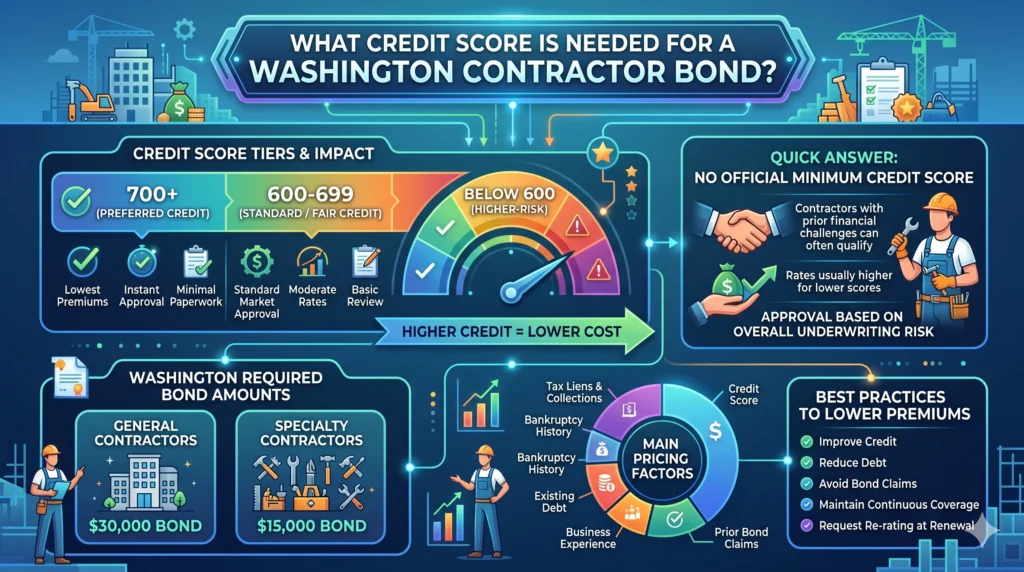
There is no official minimum credit score required to obtain a Washington contractor bond. Many contractors with lower credit scores, prior financial issues, collections, tax liens, or even bankruptcy history can still qualify for bonding through higher-risk surety markets.
However, while approval is often still possible, lower credit scores usually trigger:
- Higher annual premiums
- Additional underwriting review
- More documentation requirements
- Reduced access to preferred surety markets
Contractors with strong credit profiles generally qualify for:
- Faster approvals
- Lower rates
- Instant underwriting decisions
- Minimal paperwork
Typical approval ranges:
- 700+ (Excellent Credit): Best rates, instant approval
- 650–699 (Good Credit): Standard rates, fast approval
- 600–649 (Fair Credit): Higher premiums, still widely approved
- Below 600 (Higher Risk): May require underwriting, higher cost
Surety companies use credit history as one of the primary indicators of financial responsibility because contractor license bonds create potential repayment exposure if claims are paid.
For most Washington contractor bonds, approval is based on overall underwriting risk rather than a strict pass-or-fail credit score cutoff.
Credit score is one of the largest factors affecting Washington contractor bond pricing, underwriting approval speed, and overall long-term bonding costs. Washington Contractor License Bond Cost (2026 Guide)
How Credit Score Impacts Washington Contractor Bond Cost
Credit score is one of the biggest factors affecting Washington contractor bond pricing.
Although Washington fixes the required bond amount by law:
- $30,000 for general contractors
- $15,000 for specialty contractors
the premium contractors actually pay varies based on underwriting risk.
Contractors do not pay the full bond amount upfront. Instead, they pay an annual premium that is usually calculated as a percentage of the bond amount.
In general:
- Higher credit scores usually receive lower bond rates
- Moderate credit often qualifies for standard market pricing
- Lower credit typically results in higher premiums
For example:
- A contractor with strong credit may qualify near preferred rates around 1% to 3% of the bond amount
- Contractors with challenged credit may pay significantly higher percentages depending on financial history and underwriting concerns
Surety companies evaluate credit because contractor bonds are not traditional insurance policies. If the surety pays a valid claim, the contractor is generally responsible for reimbursing the surety company for the loss.
Surety companies closely evaluate credit risk because contractors are financially responsible for reimbursing the surety company if a valid bond claim is paid. Washington Contractor Bond Claims Explained: How Claims Work & What Happens Next
In addition to credit score, underwriters may also review:
- Tax liens
- Collections
- Bankruptcy history
- Existing debt load
- Prior bond claims
- Business experience
- Financial stability
Because of this, two contractors applying for the exact same Washington contractor bond may receive very different pricing depending on overall financial risk profile.
Hard vs. Soft Credit Pulls: Will Applying Affect Your Score?
A common concern for new business owners is whether shopping for a bond quote will ding their credit score. Fortunately, most modern surety agencies use a “soft pull” or a soft credit inquiry to provide a quote. Unlike the “hard pulls” used for mortgages or car loans, a soft pull does not lower your credit score or appear as an inquiry to other lenders. This topic provides peace of mind for contractors who want to compare multiple quotes without jeopardizing their credit standing.
Many contractors assume contractor bond applications work like traditional loans or insurance underwriting, but surety bond credit checks are typically less invasive and structured differently. Washington Contractor Bond vs Insurance – Key Differences Explained
Credit Score Tiers: Preferred, Standard & Higher-Risk Bond Rates
Surety companies commonly group Washington contractor bond applicants into general credit risk categories during underwriting. While exact pricing varies between surety carriers, contractors with stronger credit profiles almost always qualify for lower bond rates and faster approvals.
| Credit Tier | Typical Credit Profile | What to Expect |
|---|---|---|
| Preferred Credit | Strong credit, typically around 700+ FICO | Lowest annual premiums, instant approval, minimal underwriting review, and access to preferred surety markets |
| Standard / Fair-Good Credit | Average or moderate credit, typically around 600–699 FICO | Standard market approval, moderate bond rates, basic underwriting review, and standard documentation requirements |
| Higher-Risk Credit | Credit below 599 FICO, open collections, tax liens, bankruptcies, financial instability, or prior bond claims | Higher premiums, additional underwriting review, more documentation requests, and limited carrier availability; approval may still be possible through specialty surety markets |
Can You Still Get a Washington Contractor Bond With Bad Credit?
Yes. Many contractors with bad credit can still obtain a Washington contractor bond.
Unlike traditional bank financing, surety underwriting is often flexible because contractor license bonds are considered lower-limit commercial surety obligations.
Lower credit scores do not automatically prevent contractors from getting bonded, because many surety companies offer specialty programs designed for higher-risk applicants. Can You Get a Washington Contractor Bond With Bad Credit?
Other Financial Factors Surety Companies Review Besides Credit Score
Key Factors Beyond the Score: What Else Do Underwriters See?
While the three-digit score is the headline, bond underwriters also look at the “anatomy” of your credit report. They look for specific red flags like open tax liens, unpaid child support, or recent bankruptcies, which can trigger a decline even if the score seems acceptable. Conversely, an established business history and a clean licensing record with no prior bond claims can sometimes help offset a mediocre credit score. This topic helps contractors understand the qualitative side of bond underwriting.
Surety underwriting goes beyond just credit scores, especially for contractors operating in higher-risk trades or industries where licensing compliance and financial stability receive closer scrutiny. Who Needs a Washington Contractor Bond? Requirements & Exemptions Explained
Strategies to Lower Your Bond Premium at Renewal
Washington contractor bonds are typically continuous, meaning they renew annually. This provides a recurring opportunity to lower your business overhead. By improving your credit score throughout the year—such as by reducing credit card utilization or resolving old collections—you can request a “re-rate” at your next renewal. This section offers practical advice on how “credit repair” directly translates into lower insurance costs and improved cash flow for a construction business.
Washington contractor bond renewals are not just about maintaining compliance—they also create an opportunity for contractors to improve underwriting profiles and potentially reduce future bond costs. Washington Contractor Bond Renewal Process: Avoiding Bond Lapses & License Suspensions
Additional Washington Contractor Bond Requirements for Certain Trades
Some Washington contractors may be required to carry additional specialty license bonds beyond the standard contractor registration bond, depending on their trade classification and licensing requirements. Telecommunications and plumbing contractors, for example, are subject to separate state-specific bond requirements tied to their professional licensing regulations.
- Washington $4,000 Telecommunications Contractor Bond Requirements (2026 Guide)
- Washington $6,000 Plumbing Contractor Bond Requirements (2026 Guide)
Get a Washington Bond Quote Now →
Frequently Asked Questions
Related Pages:
Reviewed by: Jeremy Schaedler
Principal – Surety First Insurance Services
As principal at Surety First, Jeremy Schaedler has specialized in contractor license bonds and construction insurance since 2006. CA License: 0f06277
This information is for general informational purposes only and does not constitute legal advice. Licensing and insurance requirements may change. Contractors should verify current requirements directly with their state regulatory agency or consult qualified legal counsel.

Why Contractors Choose Surety First
- Specializing in contractor bonds and insurance since 2006 (20,000+ served)
- A-rated surety markets
- Fast approvals, often within minutes
- Direct state filing
- Serving contractors across CA, OR, WA, NV, AZ
Phone: 1-800-682-1552
Website: suretyfirst.com
Sources
- Washington State Department of Labor & Industries (L&I) – Contractor Registration
https://www.lni.wa.gov/licensing-permits/contractors/register-as-a-contractor/ - Washington State Legislature – RCW 18.27 Contractor Registration Law
https://app.leg.wa.gov/rcw/default.aspx?cite=18.27 - Washington Administrative Code (WAC) – Contractor Registration Rules
https://app.leg.wa.gov/wac/default.aspx?cite=296-200A - Washington State Department of Revenue – Business Licensing Information
https://dor.wa.gov/open-business/apply-business-license - Surety & Fidelity Association of America (SFAA) – Surety Bond Information
https://www.surety.org/ - National Association of Surety Bond Producers (NASBP) – Surety Bond Education
https://www.nasbp.org/ - Consumer Financial Protection Bureau (CFPB) – Credit Report & Credit Score Guidance
https://www.consumerfinance.gov/consumer-tools/credit-reports-and-scores/