Quick Answer: Artificial intelligence is creating a clear divide in construction: data-driven contractors are outperforming traditional contractors in bidding accuracy, profitability, and risk control. By using AI-powered estimating, scheduling, and analytics tools, these firms can predict outcomes, reduce costly errors, and deliver more consistent project results.
In contrast, contractors relying on manual processes and experience alone face greater cost overruns, delays, and financial variability. This gap is no longer just operational—it directly impacts competitiveness, insurance costs, and bonding capacity, making data-driven decision-making a critical advantage in today’s construction market.
Key Facts: AI in Construction (2026)
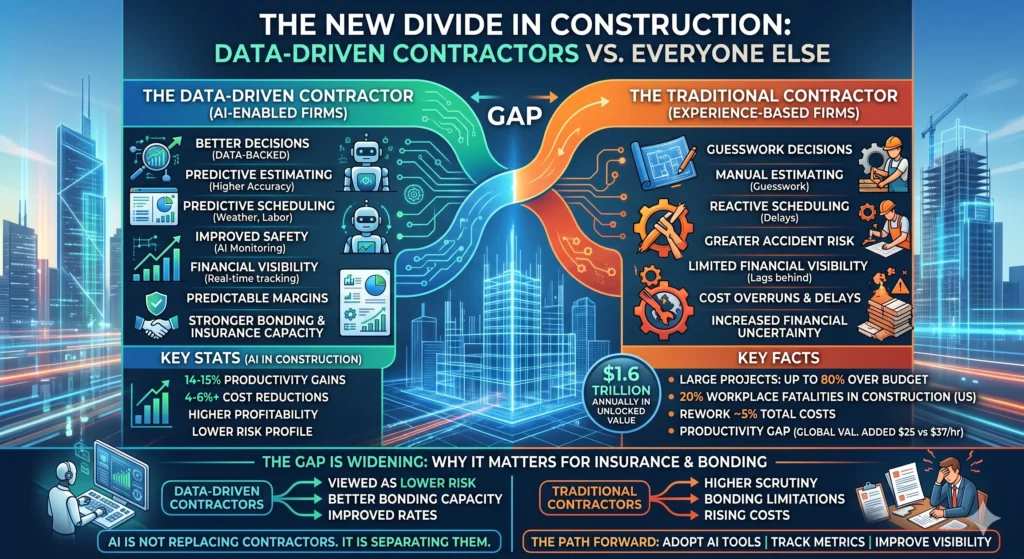
~20% of U.S. workplace fatalities occur in construction, highlighting the industry’s high-risk profile.
Large construction projects typically run up to 80% over budget and 20% behind schedule, according to McKinsey.
AI-driven tools can deliver 14–15% productivity gains and 4–6% cost reductions.
Rework accounts for ~5% of total construction costs, often due to poor data and coordination.
Data-driven contractors benefit from more accurate bidding, stronger margins, and more predictable outcomes.
AI enables predictive scheduling by analyzing weather, labor availability, and supply chain risks.
Contractors using AI are increasingly viewed as lower risk by insurers and sureties.
The industry faces a growing divide between data-driven firms and traditional contractors.
Closing the construction productivity gap could unlock up to $1.6 trillion annually in global value.
AI adoption is shifting from a competitive advantage to a baseline requirement for larger projects.
The shift isn’t coming—it’s already here
Bridging the Productivity Gap: As the construction industry digitizes, a structural divide is emerging between firms utilizing AI for predictive risk management and those relying on traditional manual processes.
For decades, construction has run on experience.
Estimators relied on gut instinct. Project managers reacted to problems as they surfaced. Financial visibility lagged behind reality. And risk—arguably the most important variable in construction—was often only understood after something went wrong.
That model is breaking.
Artificial intelligence (AI) and data-driven systems are not just improving construction workflows—they are creating a measurable divide between contractors who can predict outcomes and those who can’t.
And that divide is beginning to show up in the places that matter most:
While AI has become a buzz word as of late for solving a host of societal issues, the core problem runs much deeper in construction. The problem? Digitization. Specifically- the lack of it in the construction industry. Productivity cannot improve without efficiency gains and these gains cannot be achieved by using outdated, manual/paper sourced processes that do not take advantage of automation. According to one report, the construction industry is amongst the least digitized industries trailing only agriculture and hunting. Without digitization, data has no value. No data, no AI efficiency bump and no productivity gains.
How deep is the problem? Lets take a look.
Construction has a data problem—and AI is solving it
The construction industry has long struggled with productivity and predictability. According to McKinsey & Company, large construction projects typically run over budget by 80% and behind schedule by up to 20%.
That level of variance isn’t just operational—it’s financial risk.
AI changes that equation by doing what contractors historically couldn’t:
Aggregating job data across projects
Identifying patterns in cost overruns
Predicting delays before they happen
Flagging risk in real time
Instead of reacting, contractors can now forecast outcomes with increasing accuracy. That is of course, if they have embraced digital platforms as part of their current operations. Contractors scribbling notes on handwritten contracts are in no position to benefit from any of the potential benefits AI can offer.
What “data-driven” actually looks like in 2026
This isn’t theoretical. AI is already embedded in tools contractors are using every day.
Estimating is becoming predictive
AI-powered estimating platforms analyze:
Historical cost data
Material fluctuations
Labor productivity trends
The result is tighter bids—and fewer “bad wins” where contractors secure a project but lose money executing it.
Jobsite safety is becoming measurable
AI-enabled monitoring systems can:
Detect PPE violations
Identify unsafe behavior
Predict incident patterns
According to Occupational Safety and Health Administration, construction consistently ranks among the highest-risk industries for workplace injuries and according to the Bureau of Labor Statistics, construction accounts for ~20% of all U.S. workplace fatalities. Reducing incidents doesn’t just save lives—it directly impacts:
Instead of reacting to delays, contractors can anticipate and mitigate them.
Financial performance is becoming visible in real time
AI systems now provide:
Cash flow forecasting
Margin tracking by project
Early warnings of cost overruns
This level of visibility fundamentally changes how contractors manage risk. This isn’t about “better reporting.” It’s about moving from finding out you lost money after the job to preventing the loss while the job is still in progress.
How are these factors influencing construction in 2026?
Two types of contractors are emerging
This is where the divide becomes clear.
The data-driven contractor
These firms:
Use AI-enabled systems across estimating, operations, and finance
Track performance metrics consistently
Make decisions based on data, not instinct
Outcome:
Predictable margins
Fewer surprises
Stronger financials
The traditional contractor
These firms:
Rely on experience and manual processes
Have limited real-time visibility into job performance
Operate reactively
Outcome:
Higher variability
Greater exposure to cost overruns
Increased financial uncertainty
A Structural Shift: The widening gap in the construction industry between data-centric firms that leverage AI for predictability and traditional firms that rely on reactive, experience-based decision-making.
The competitive gap is widening
This isn’t just an operational difference—it’s a competitive one.
Contractors using data-driven estimating tools report significantly reduced bid errors and rework tied to misestimation. They claim AI integrated in their tools can lead to enhanced productivity, better decision making, higher quality outcomes and improved safety.
Data-driven contractors are:
Bidding more accurately
Protecting margins
Delivering more consistent results
Traditional contractors are increasingly:
Underbidding and losing money
Overbidding and losing work
Struggling to compete on larger projects
The gap is no longer subtle—it’s structural. According to McKinsey, the global value added in the construction industry stands at about $25/worker hour while the global economy as a whole stands at $37/hour. Closing this productivity gap through technology and specifically AI, could dramatically increase total output. This gap, if closed, could result in up to $1.6 trillion per year in global construction productivity gains.
Why this matters for insurance and bonding
This is where the conversation shifts from technology to capital access and risk evaluation.
From a surety and underwriting perspective, the most important question is simple:
How predictable is this contractor?
Can contractors demonstrate:
Consistent financial performance
Documented job outcomes
Lower variability across projects
Contractors exhibiting these traits are inherently viewed as lower risk and will increasingly be rewarded with the higher bonding capacity and lower rates- a sustainable long term advantage for technologically savvy contractors over their more traditional counterparts.
Firms like Surety First Insurance Services are already seeing this shift play out—not as a future trend, but as a present reality. This is no longer a hypothetical scenario but a real on the ground movement that any contractor, small or large can either evolve with or get left behind.
AI isn’t just reducing risk—it’s making it visible
One of the most important—and overlooked—impacts of AI is transparency.
Data-driven contractors generate:
Detailed project records
Safety logs
Performance metrics
This creates a clearer picture for:
Sureties
Insurers
Project owners
Regulators
Contractors without this data increasingly appear:
Less predictable
Less controlled
Higher risk
Even if their actual performance hasn’t changed. Its quite simple- no amount of luck or intuition will allow a traditional contractor outperform a data driven contractor with better processes over the long run.
How can traditional contractors transition do data driven?
Going back to the digitization factor discussed earlier- the first step is moving away from paper based business processes. While this is inconvenient, it needs to be done for contractors to stay relevant going forward. Once a contractor has digitized their operation, they can then embrace some of the AI tools that are driving construction industry efficiency.
The hidden risk: AI doesn’t eliminate liability
There’s a second side to this shift.
While AI reduces many traditional risks, it introduces new ones:
Overreliance on automated decision-making
Faulty data inputs leading to incorrect forecasts
Legal exposure tied to documented system recommendations
As AI becomes embedded in workflows, questions emerge:
If an AI system miscalculates a schedule, who is responsible?
If safety monitoring flags are ignored, how is liability assigned?
The legal and insurance frameworks are still catching up. This problem is real. While AI can rapidly improve operations it is not a set it and forget it solution as this point in its evolution. It needs to be used and viewed as productivity assistance tool as opposed to a replacement of existing processes and their checks and balances.
Small contractors face the biggest pressure
Larger contractors have already begun adopting AI at scale as the gains are much larger for them, the resources to implement are easier and the infrastructure of current digitized processes allows for a smaller learning/adaption curve.
Smaller contractors face a different reality:
Limited resources
Slower adoption cycles
Increasing expectations from owners and GCs
The result is pressure from both sides:
Competing against more efficient firms
Meeting higher reporting and performance standards
This is where the divide becomes most visible. What technology tools are being implemented most commonly to improve productivity in construction? According to a report by JBKnowledge, these tools lead the way:
Robotic Total Stations
3D Scanners
Tigerstop
Small contractors face the greatest pressure in adopting AI, as they must compete against more efficient, data-driven firms while meeting rising expectations from owners and general contractors with fewer resources. At the same time, productivity is increasingly driven by tools like robotic total stations, 3D scanners, and TigerStop systems, which are becoming standard among higher-performing contractors.
AI adoption is becoming a baseline requirement
What was once a competitive advantage is quickly becoming a baseline expectation.
Owners, developers, and lenders are starting to prioritize:
Data transparency
Predictable outcomes
Documented performance
Contractors who cannot provide that may find themselves:
Limited in project size
Facing stricter underwriting
Losing access to higher-value opportunities
The bottom line- AI is not replacing contractors. It is separating high-performing contractors from everyone else. The divide is not about technology—it’s about predictability, risk control, and financial consistency.
And increasingly, access to:
Capital
Insurance
Bonding capacity
AI adoption in construction is rapidly accelerating—it’s becoming a baseline requirement as owners, lenders, and developers demand data transparency, predictable outcomes, and documented performance. Contractors who fail to adopt risk losing access to larger projects, favorable underwriting, and critical resources like capital, insurance, and bonding capacity.
What contractors should do now
The path forward doesn’t require a complete overhaul.
It requires focus:
Digitize your processes
Start with estimating and project management tools that include AI capabilities
Track performance metrics consistently
Improve financial visibility across projects
Build documentation that reflects actual job performance
The goal is not to “adopt AI”—it’s to become measurably more predictable.
Category
Data-Driven Contractors
Traditional Contractors
Estimating
AI-powered, data-backed bids with higher accuracy
Manual estimates based on experience and guesswork
Bidding Results
Win profitable jobs with tighter margins
Underbid and lose money or overbid and lose work
Scheduling
Predictive scheduling using AI (weather, labor, supply chain)
Reactive scheduling with delays addressed after they occur
Project Outcomes
Consistent delivery with fewer surprises
High variability and frequent overruns
Financial Visibility
Real-time tracking of margins, cash flow, and risk
Limited visibility, issues identified too late
Safety & Risk
AI-driven monitoring reduces incidents and claims
Higher exposure to accidents and costly claims
Insurance & Bonding
Viewed as lower risk; potential for better rates and higher capacity
Higher scrutiny, potential limitations on bonding capacity
Decision Making
Data-driven and predictive
Experience-based and reactive
Competitive Position
Scalable, efficient, and winning higher-value projects
Falling behind and competing on thinner margins
Final perspective
The construction industry is entering a phase where data is no longer optional.
Contractors who embrace it will:
Scale faster
Win better work
Strengthen their financial position
Those who don’t will increasingly find themselves:
Competing on thinner margins
Facing greater scrutiny
Falling behind
AI is no longer a future advantage in construction—it is actively separating high-performing, data-driven contractors from those relying on outdated processes. Firms that leverage data and predictive tools are achieving more consistent results, stronger margins, and lower risk profiles, which directly impacts their competitiveness and access to capital. Meanwhile, traditional contractors face increasing pressure as variability, inefficiency, and lack of visibility limit their ability to compete. The contractors who adapt to data-driven decision-making will not only survive this shift—they will define the future of the industry.
By: Jeremy Schaedler Principal – Surety First Insurance Services
This information is for general informational purposes only and does not constitute legal advice. Licensing and insurance requirements may change. Contractors should verify current requirements directly with their state regulatory agency or consult qualified legal counsel.
Jeremy founded Surety First Insurance Services (formerly Schaedler Insurance) shortly after graduating from the University of California, Los Angeles with a bachelor’s degree in Economics. Based in Northern California, the agency specializes in providing insurance and surety bond solutions for construction professionals throughout California, Oregon, Washington, Nevada and Arizona.
With a strong focus on service and industry expertise, Jeremy has built Surety First into a trusted resource for contractors seeking reliable insurance and bonding support.
Jeremy is happily married and the proud father of two young boys. Outside of work, he enjoys camping, fishing, and spending time with friends and family.
CA Insurance License #0F06277
HAVE BONDING OR INSURANCE QUESTIONS?
Call us today at 1-800-682-1552 to speak with a licensed contractors insurance specialist.
Quick Answer: Recent spikes in California contractor license bond premiums (up 25–50% in some samples) are likely not caused by surety rate hikes for the most part, but…
Updated for 2026 Legislative Session California Assembly Bill 1406 (AB 1406) is pending legislation that could impact how purchaser deposits are handled in certain real estate transactions involving…
Beginning January 1, 2026, Oregon landscape contracting businesses are required to carry a standardized $20,000 surety bond under changes driven by Senate Bill 864. This update affects both…
Hang tight!
We’re fetching information from the contractors board to expedite your quote.