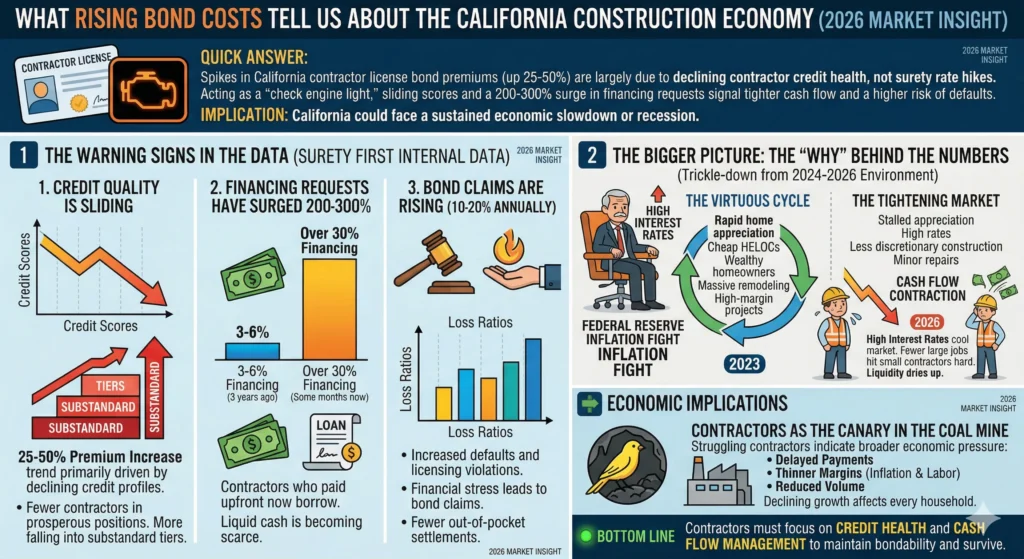
Quick Answer: Recent spikes in California contractor license bond premiums (up 25–50% in some samples) are likely not caused by surety rate hikes for the most part, but a widespread decline in contractor credit health and accumulated debt. Because these bonds are credit-based, sliding scores and a 200-300% surge in financing requests act as a “check engine light” for the industry, signaling tighter cash flow and a higher risk of defaults across the state moving forward.
The implication? If deteriorating contractor credit and rising debt reach an unsustainable tipping point, California could be heading for a period of sustained economic slowdown or recession.
Key Facts: Is The California Construction Economy In Trouble? (2026)
📈 Rising Premiums: Average bond costs have increased 25–50% over the last four years collectively from our data, primarily driven by declining contractor credit scores rather than rate hikes.
💳 Financing Surge: Requests for bond financing have spiked 200–300% in some instances, signaling that liquid cash is becoming scarce at the ground level.
⚠️ Claim Escalation: Internal data suggests bond claim loss ratios are rising 10–20% annually as financial stress makes it harder for contractors to settle disputes out-of-pocket.
🏠 Reinvestment Gap: High interest rates have stalled home equity growth, shifting demand away from high-margin projects toward minor, necessary repairs.
🛡️ Business Protection: In this high-risk environment, contractors must prioritize credit health and liquidity to maintain their bondability and avoid terminal claims.
What Is a California Contractors License Bond?
A California contractor license bond is a $25,000 surety bond required by the state that guarantees a contractor will follow licensing laws and regulations. If the contractor violates those laws or causes financial harm, a claim can be filed against the bond and the surety may pay damages. The contractor is ultimately responsible for repaying any claims, making the bond a financial guarantee—not insurance.
If you’re a California contractor that has opened their renewal notice lately and felt a sting, you aren’t alone. Across California, average contractor license bond premiums have jumped as much as 25-50% collectively over the last four years according to recent data.
On the surface, it looks like the stereotypical “just another price hike” and “money grab” by greedy insurance carriers getting handsy with contractors wallets. This time, we may be seeing something totally different and potentially far reaching beyond California contractors.
When taking a look under the hood at what’s really driving these increases we find the usual stereotypical claims don’t seem to hold water. Something bigger is brewing, but what?
Here’s the puzzle:
Facts:
1. Contractors today are, on average, paying a lot more for their contractor bonds than they did 3-4 years ago.
2. Contractors with good credit are paying roughly the same or very similar to what they did 3-4 years ago.
3. Contractors with challenged credit are also paying roughly the same amount as they did 3-4 years ago.
What’s changed is there seems to be a much higher percentage of contractors experiencing declining credit scores, rising debt and as a result, moving from a good credit, low bond cost scenario to a challenged credit and higher cost profile.
Along with higher premiums, we’re also seeing a marked increase in surety bond financing requests. With the primary surety’s (insurance companies) we work with, there hasn’t been a slew of official rate hike filings, if any, or new and disruptive legislation driving this phenomena. Instead, the data indicates to us that the contractors surety bond market is acting like a “check engine light” for the entire California construction industry.
If contractors as a whole are struggling with credit challenges and potentially higher debt loads more frequently, what’s on the horizon for the economy moving forward? Are we quietly coasting towards a significant economic downturn?
Here is what the data is telling us about the financial health of contractors in 2026.
The “Check Engine Light” for California Construction: A deep dive into how rising surety bond costs and a 300% surge in financing requests signal a tightening market and a potential broader economic slowdown in 2026.
The $25,000 Bond: A Contractors Financial Fingerprint
In California, a contractors $25,000 license bond is essentially a line of credit. Because contractors are legally obligated to repay every bond claim, surety companies price bonds based primarily on one factor above all others: a contractors creditworthiness.
When bond premiums go up without a broad structural change in the law or significant bond marketplace disruptions, it potentially indicates the “financial fingerprint” of the average contractor could be changing for the worse.
The Warning Signs in the Data
Based on internal data at Surety First covering 20,000+ licensed contractor clients over roughly 20 years, we are seeing three specific trends that signal a tightening market:
1. Credit Quality is Sliding
Since bond pricing is tied to credit scores, the 25-50% premium increase trend we’re seeing is almost entirely driven by declining credit profiles and/or rising debt as far as we can tell. It is difficult even with internal data covering thousands of contractors to arrive at precise, indisputable fact driven conclusions, but the broad financial picture seems clear. Contractors do not appear to be in the same prosperous financial position on average as they were three years ago. More contractors are falling into “substandard” credit tiers, which automatically triggers higher bond rates.
This trend would seem to match a data set released by Lending Tree last month which showed consumer credit card debt has increased by 66% since 2021 and has reached a record $1.28 trillion according to Forbes, an all time high. Some quick math shows that’s $3,862 of debt for every man, woman and child in the U.S. If debt continues to rise and construction work dry’s up, defaults could escalate quickly.
2. Financing Requests have Surged 200-300%
Perhaps the most telling statistic is the roughly 200-300% increase in requests for financed bonds both from new quote requests from non-customers and renewals of existing customers. Admittedly this data can potentially be a little misconstrued and amplified in magnitude by a small subset of contractors, but the bigger picture is astounding. Requests for financed bonds were roughly 3-6% of bond sales 3 years ago, and now, in some months, we are seeing over 30%. That’s a massive escalation for a relatively inexpensive product.
The Translation: Contractors who used to pay their premiums upfront are now choosing to borrow the money. What’s worse, the interest rates charged by premium financing companies is not cheap, often exceeding credit card rates. This indicates that liquid cash is becoming scarce on the ground level as well as reduced availability of low cost financing alternatives.
3. Bond Claims are Rising (10–20% Annually)
Loss ratios—the amount sureties pay out in claims—are climbing according to our internal data. Broader market reports corroborate this trend. A news release by A.M. Best in early 2025 pointed out:
“direct loss ratio of 25.0% during the first nine months of 2024 was the highest in five years, driven mostly by increased claims costs tied primarily to economic inflation, as well as other challenges contractors face, including a tight labor market.”
When contractors are under financial stress, they are more likely to run into the types of disputes that trigger a bond claim. It’s the exact reason bond premiums are directly tied to a contractors credit score. During prosperous economic conditions, contractors are much more likely to work things out with disgruntled customers- even if they feel they are not in the wrong. When construction is booming, it’s often easier to appease a disgruntled customer and move on to the next job than squabble over minor disagreements. The opportunity cost is too high. In fact, many disputes in boom times get settled before a claim is filed.
When times get tough, for some contractors, there is no next job to move on to. Contract disputes that were previously settled before a bond claim was filed, are now turning into elongated legal battles.
Another major point of frustration amongst construction professionals that’s not often discussed outside contractor circles- its not uncommon for project owners to stiff contractors and file bond claims not because of a true law violation, but because they too are under financial duress and unable to pay contractors for otherwise satisfactorily completed construction work. Searching for contractual loopholes can sometimes be easier than admitting funds to pay for otherwise properly completed work is tight or unavailable. Filing a bond claim is conveniently easy and free to the filer and at least buys time to negotiate a settlement while a contractor is under licensing pressure from the CSLB to resolve the dispute or face disciplinary action. This is most certainly not always the case when a claim is filed as legitimate contractor violations do occur regularly, but it absolutely occurs too frequently from our experience. In fact- seasoned professionals in our industry often point to increased instances of delayed or non payments to contractors as one of the most common early indicators of impending economic slow down.
“Many surety bond claims may seem minor at first—like a small payment bond claim due to past-due payables. However, as surety providers dig deeper during their claims investigations, they often discover far more significant financial problems….”
“In several cases, contractors have approached surety providers for financial assistance to maintain performance on bonded projects. This assistance typically comes in two forms:
Direct financing: Contractors request sureties to pay for payroll and operational costs.
Indirect financing: Contractors ask sureties to resolve payment bond claims or pay their outstanding bills.”
Contractors turning to insurance companies in the event of a claim to cover costs of ongoing operations is a major red flag for liquidity issues.
Market Indicator
2023: Virtuous Cycle
2026: Tightening Market
Contractor Impact
Average Bond Premium
Baseline / Stable
25–50% Increase
Higher fixed overhead costs
Credit Tier Distribution
Mostly standard or preferred
Shift toward substandard
Lower credit scores mean higher rates
Premium Payment Preference
Paid upfront / in full
200–300% surge in financing
Less liquid cash available for operations
Bond Claim Loss Ratios
Low / manageable
Rising 10–20% annually
More legal disputes and defaults
Home Reinvestment
High, fueled by HELOCs
Low, pressured by high rates
Fewer high-margin luxury projects
Dispute Resolution
Quick out-of-pocket settlement
Escalation to bond claim
Long-term damage to bondability
The Bigger Picture: A “Quiet” Downturn?
This isn’t just a “bond story”—it’s a story about contractor survival. Contractors are often the canary in the coal mine with regards to the overall economic health in our economy. Contractors struggling in an increasingly more common fashion should be a real concern for even non contractors. After all, declining economic conditions reaches far beyond the construction industry. It reaches every household in the country in many different predictable and unpredictable ways.
The financial trends we are seeing amongst California contractors could be an early warning sign of a broader economic shift. When we see cash flow tightening and credit under pressure, it usually stems from:
Delayed Payments: Contractors waiting longer to get paid by owners or GCs.
Thinner Margins: Inflation and labor costs eating into the “bottom line.”
Reduced Volume: Fewer new projects starting, leaving less “cushion” in the bank.
The “Why” Behind the Numbers: Possible Causes
The data suggests we could be seeing the “trickle-down” effect of the broader 2024–2026 economic environment. While the bond premium increases many contractors are seeing may feel like a rate hike, the roots of the problem could lie in the Federal Reserve’s long-term fight against inflation.
High Interest Rates & The “Wealth Effect”
For years, California contractors benefited from a “virtuous cycle”: home prices appreciated rapidly, and low interest rates made HELOCs (Home Equity Lines of Credit) nearly free money. Homeowners felt wealthy and were eager to reinvest that equity into massive remodeling and construction projects.
Today, that cycle has reversed:
Stalled Appreciation: High interest rates have cooled the housing market. With home price growth slowing, homeowners are no longer seeing the massive monthly equity gains they once did.
The Reinvestment Gap: When equity growth slows and borrowing costs rise, “discretionary” construction is the first thing to go. Homeowners are opting for minor repairs over major structural additions or high-end remodels.
Cash Flow Contraction: This drop in high-margin project reinvestment hits small-to-midsize contractors hardest. With fewer large-scale jobs to pad their accounts, liquidity dries up, leading to the surge in bond financing we are seeing today.
The Bottom Line
The spike in surety bond costs could be a blip on the radar of an otherwise healthy economy or it could signal that the California construction market, and broader economy as a whole, is under significant financial pressure. The contractors who focus on credit health and cash flow management today are the ones who will be standing when the market eventually resets.
Frequently Asked Questions – Construction Market Trends (2026)
Why are more contractors financing their bond premiums?
Financing requests have surged 200%–300%, signaling that many contractors have less available cash and tighter liquidity than in previous years.
Are bond claims increasing as well?
Yes. Internal and market data suggest bond claim activity is rising 10%–20% annually, often tied to financial stress, disputes, and cash flow issues.
How do credit scores impact bond costs?
Credit is the primary pricing factor for contractor license bonds. Lower credit scores move contractors into higher premium tiers, increasing costs even if rates stay the same.
Are contractors experiencing more financial pressure overall?
Yes. Trends point to:
Higher debt levels
Slower payments from project owners
Reduced project volume
Thinner profit margins
These factors combine to create cash flow constraints across the industry.
Why are disputes and bond claims becoming more common?
In tighter markets, contractors are less able to settle disputes out-of-pocket. At the same time, project owners under financial stress may delay payment or escalate disputes, increasing claim frequency.
How do interest rates impact contractors?
Higher interest rates reduce home equity growth and increase borrowing costs, which leads to:
Fewer large remodeling projects
Reduced high-margin work
Lower cash flow for contractors
What is the biggest risk for contractors right now?
The biggest risk is declining liquidity combined with rising debt, which can lead to:
Higher bond costs
Increased likelihood of claims
Loss of bondability
How can contractors protect themselves?
Best practices include:
Maintaining strong credit
Managing debt levels
Preserving cash flow
Avoiding unnecessary financing
Resolving disputes early to prevent claims
Is this a sign of a broader economic slowdown?
Possibly. The data suggests the construction industry may be entering a tightening cycle, which can precede broader economic slowdown if conditions worsen.
By: Jeremy Schaedler Principal – Surety First Insurance Services
This information is for general informational purposes only and does not constitute legal advice. Licensing and insurance requirements may change. Contractors should verify current requirements directly with their state regulatory agency or consult qualified legal counsel.
Jeremy founded Surety First Insurance Services (formerly Schaedler Insurance) shortly after graduating from the University of California, Los Angeles with a bachelor’s degree in Economics. Based in Northern California, the agency specializes in providing insurance and surety bond solutions for construction professionals throughout California, Oregon, Washington, Nevada and Arizona.
With a strong focus on service and industry expertise, Jeremy has built Surety First into a trusted resource for contractors seeking reliable insurance and bonding support.
Jeremy is happily married and the proud father of two young boys. Outside of work, he enjoys camping, fishing, and spending time with friends and family.
CA Insurance License #0F06277
HAVE BONDING OR INSURANCE QUESTIONS?
Call us today at 1-800-682-1552 to speak with a licensed contractors insurance specialist.
Quick Answer: Artificial intelligence is creating a clear divide in construction: data-driven contractors are outperforming traditional contractors in bidding accuracy, profitability, and risk control. By using AI-powered estimating,…
Updated for 2026 Legislative Session California Assembly Bill 1406 (AB 1406) is pending legislation that could impact how purchaser deposits are handled in certain real estate transactions involving…
Beginning January 1, 2026, Oregon landscape contracting businesses are required to carry a standardized $20,000 surety bond under changes driven by Senate Bill 864. This update affects both…
Hang tight!
We’re fetching information from the contractors board to expedite your quote.