
 Fast, Free and No Risk



How to Renew Your Arizona Contractor License Bond

Updated for 2026 Requirements
Quick Answer: Renewing your Arizona contractor license bond is required to keep your license active with the Arizona Registrar of Contractors (ROC). Your bond must remain continuously in force—if it expires or cancels, the ROC can suspend your license and stop you from legally working.
Most contractor bonds are written on a 12-month term and must be renewed annually. The process is straightforward: your surety sends a renewal notice, you pay the premium, and the bond continues without interruption. The key is timing—missing a deadline can trigger a lapse, cancellation notice, and potential license suspension.
Before handling renewal deadlines and avoiding lapses, it’s important to understand how Arizona contractor license bonds work and why they’re required. Arizona Contractor License Bond
Arizona Contractor Bond Renewal – Key Facts
- Core Requirement: Your Arizona contractor license bond must stay active to keep your ROC license in good standing
- Renewal Term: Most contractor bonds are written for 12 months and renew annually
- Renewal Notice: Sureties typically send renewal notices 30–60 days before expiration
- Best Timing: Renew at least 1–2 weeks before expiration to avoid lapse risk
- Lapse Risk: If your bond expires or cancels, the ROC can suspend your license
- Renewal vs. Re-Issue: A renewal keeps the same bond active; a re-issue creates a new bond and may require ROC re-filing
- Bond Amount Changes: Your required amount may change if your classification, revenue, or ROC requirement changes
- Auto-Renewal: Auto-pay and renewal reminders help prevent missed deadlines
- Compliance Check: Confirm your renewed bond remains active and on file with the ROC. The ROC provides a free online renewal checklist here.
- Biggest Mistake: Waiting until the last minute, which can trigger cancellation notices and license problems
▶ View Transcript
[00:00] If your Arizona contractor bond expires—even for a day—your license can be suspended.
[00:04] Your bond must stay active at all times with the Arizona Registrar of Contractors. Most bonds renew annually, and missing a deadline can shut down your ability to work.
[00:12] Here’s the process: your surety sends a renewal notice 30 to 60 days before expiration. You pay the premium, and your bond continues with no interruption.
[00:19] If you don’t pay, the surety may issue a cancellation notice. After that, your license can be suspended until a new bond is filed.
[00:27] The biggest mistake contractors make? Waiting too long. Even a short lapse can delay jobs, permits, and payments.
[00:33] Best practice: renew at least one to two weeks early and confirm your bond is still active with the ROC.
[00:39] If your bond stays active, it renews seamlessly. But if it lapses, you may need a new bond issued and re-filed—which can delay your license.
[00:46] You can also set up auto-renewal to eliminate the risk completely and keep your business running without interruption.
[00:52] Bottom line: staying ahead of your renewal is the simplest way to avoid suspension and protect your business.
[00:56] Visit SuretyFirst.com and start your Arizona contractor bond quote today.
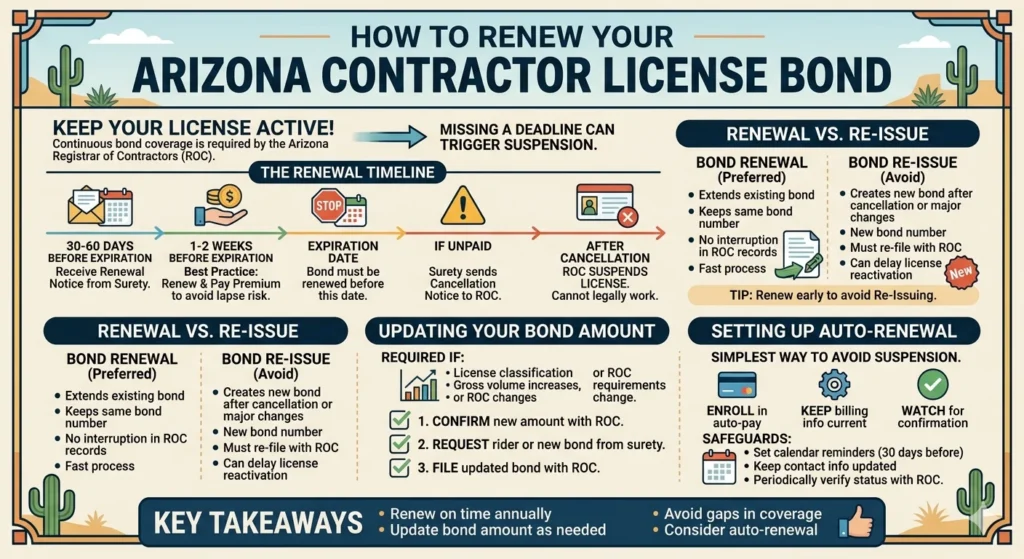
Important Renewal Deadlines to Avoid ROC Suspensions
The ROC requires uninterrupted bond coverage. Here’s how the timing works:
- 30–60 days before expiration: You receive a renewal notice from your surety
- Before the expiration date: You must pay the renewal premium
- If unpaid: The surety may issue a cancellation notice to the ROC (often 30 days)
- After cancellation: Your license can be suspended until a valid bond is filed
Best practice:
- Renew at least 1–2 weeks before expiration
- Confirm your bond remains active and on file with the ROC
Even a short lapse can delay projects, permits, and payments.
The Difference Between a Bond Renewal and a Re-Issue
Understanding this distinction prevents licensing delays:
Bond Renewal
- Extends your existing bond for another term
- Keeps the same bond number and coverage in place
- No interruption in ROC records
- Fast and preferred option
Bond Re-Issue
- A new bond is created (new number, new filing)
- Typically required if your bond was canceled, expired, or needs major changes
- Must be re-filed with the ROC
- Can delay license reactivation
Bottom line: renew early to avoid re-issuing, which adds friction and risk.
| Comparison Point | Bond Renewal | Bond Re-Issue |
|---|---|---|
| What It Means | Extends your existing bond for another term | Creates a new bond after expiration, cancellation, or major changes |
| Bond Number | Usually stays the same | Usually receives a new bond number |
| ROC Filing | No interruption in ROC records | Must be re-filed with the ROC |
| License Impact | Keeps license active when paid on time | Can delay license reactivation |
| Best Use Case | Annual renewal before expiration | Expired, canceled, or materially changed bond |
| Best Practice | Renew 1–2 weeks before expiration | Avoid when possible by renewing early |
How to Update Your ROC Bond Amount During Renewal
Your required bond amount may change if:
- Your license classification changes
- Your anticipated gross volume increases
- The ROC updates your requirement
To update your bond:
- Confirm the new required amount with the ROC
- Request a bond rider (increase/decrease) or new bond from your surety
- Ensure the updated bond is filed with the ROC before the effective date
If your bond amount is too low, your license may be flagged as non-compliant.
Your bond amount isn’t fixed—changes in your business or ROC requirements can trigger updates, making it critical to understand how those amounts are determined. Arizona Contractor Bond Amount Requirements (ROC Guide)
Avoiding Gaps in Coverage: Setting Up Auto-Renewal
The simplest way to avoid suspension is to set up automatic renewal:
- Enroll in auto-pay with your surety or agency
- Keep billing information up to date
- Watch for confirmation that the bond renewed successfully
Additional safeguards:
- Add calendar reminders 30 days before expiration
- Keep contact info current to receive renewal notices
- Verify your bond status periodically with the ROC
Bottom Line
Your Arizona contractor license bond must stay active at all times. Renewing early, updating your bond amount when required, and setting up auto-renewal are the easiest ways to avoid lapses, prevent ROC suspension, and keep your business operating without interruption.
Once you understand how to keep your bond active, the next step is knowing what it will cost—and what factors impact your renewal premium. How Much Does an Arizona Contractor License Bond Cost?
Ready to renew or update your bond without delays? Start your Arizona contractor bond quote in minutes.
Get a Arizona Bond Quote Now →
Related Pages:
- Arizona Contractor License Bond
- How to Get an Arizona Contractor License Bond as a New Applicant
- Arizona Taxpayer Bond For Contractor
Reviewed by: Jeremy Schaedler
Principal – Surety First Insurance Services
As principal at Surety First, Jeremy Schaedler has specialized in contractor license bonds and construction insurance since 2006. CA License: 0f06277
This information is for general informational purposes only and does not constitute legal advice. Licensing and insurance requirements may change. Contractors should verify current requirements directly with their state regulatory agency or consult qualified legal counsel.

Why Contractors Choose Surety First
- Specializing in contractor bonds and insurance since 2006 (20,000+ served)
- A-rated surety markets
- Fast approvals, often within minutes
- Direct state filing
- Serving contractors across CA, OR, WA, NV, AZ
Phone: 1-800-682-1552
Website: suretyfirst.com
Sources
- Arizona Registrar of Contractors
- Arizona Contractor Bond Requirements
- Arizona Revised Statutes Title 32 Chapter 10
https://www.azleg.gov/arsDetail/?title=32 - Surety & Fidelity Association of America
https://www.surety.org - National Association of Surety Bond Producers
https://www.nasbp.org