
 Fast, Free and No Risk



Arizona Taxpayer Bond For Contractor
 Updated for 2026 Requirements
Quick Answer: An Arizona taxpayer bond is required by the Arizona Department of Revenue for contractors considered a higher risk for unpaid taxes, ensuring the state can recover owed amounts if taxes aren’t properly reported or paid. Most contractors pay 1% to 5% of the bond amount annually (typically $100 to $2,500), and approval is usually fast—even with less-than-perfect credit.
Arizona Taxpayer Bond for Contractors – Key Facts
- Required By: Arizona Department of Revenue (ADOR)
- Core Purpose: Ensures contractors properly collect, report, and pay state taxes (primarily TPT)
- Who Needs It: Contractors flagged for tax compliance risk, delinquent taxes, or license reinstatement
- Not Required for All: Only mandated when ADOR determines elevated risk of non-payment
- Typical Cost: 1% to 5% of the bond amount annually for qualified applicants
- Higher-Risk Pricing: 5% to 10%+ depending on credit score and tax history
- Bond Amount: Set by ADOR based on tax liability, revenue volume, and compliance history
- Approval Speed: Most contractors can get approved within minutes to a few hours
- Payment Options: Annual payment or financing (typically 20%–25% down with installments)
- Bond Term: Usually continuous with annual renewal requirements
- Main Risk: If taxes are not paid, the state can file a claim and you must repay the surety in full
- Compliance Impact: Failure to maintain the bond can result in tax license suspension or revocation
- Best Practice: Stay current on tax filings, maintain strong credit, and renew your bond on time to avoid enforcement action
▶ View Transcript
[00:00] How much does an Arizona taxpayer bond cost—and do you actually need one?
[00:03] Here’s the straight answer in under 60 seconds.
[00:06] An Arizona taxpayer bond is required by the Arizona Department of Revenue when a contractor is considered a higher risk for unpaid taxes.
[00:11] It guarantees that you’ll properly collect and pay state taxes—usually Transaction Privilege Tax, or TPT.
[00:16] If you don’t, the state can file a claim against the bond—and you’re required to repay it.
[00:20] Here’s what most contractors misunderstand: you do not pay the full bond amount.
[00:24] You typically pay just 1% to 5% per year, depending on your credit and risk profile.
[00:28] So a $22,000 bond might cost around $220 to $1,100 annually.
[00:32] Even with lower credit, most contractors can still get approved—just at a higher rate.
[00:36] And in many cases, you can finance the bond with a small down payment.
[00:40] The key is this: not all contractors need a taxpayer bond—it’s only required when the state flags risk.
[00:45] But if you are required to carry one, it’s not optional.
[00:48] Let it lapse, and your tax license can be suspended—meaning you can’t legally operate.
[00:52] Bottom line: it’s fast to get, relatively low cost, and critical for staying compliant.
[00:56] Get your Arizona taxpayer bond quote today at SuretyFirst.com and see your exact rate.
What Is an Arizona Taxpayer Bond for Contractors?
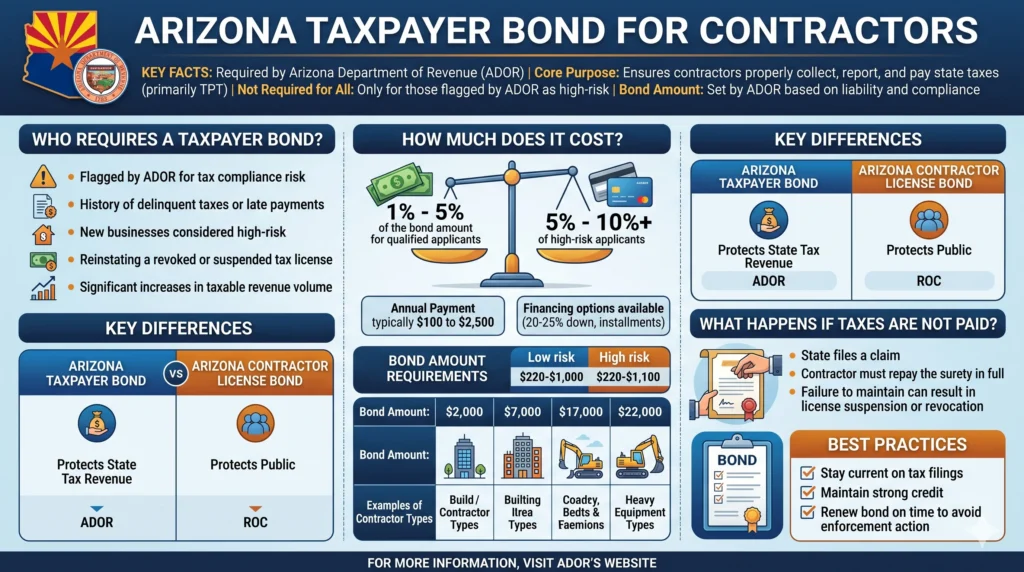
An Arizona taxpayer bond is a financial guarantee required by the Arizona Department of Revenue to ensure a contractor properly collects, reports, and pays state taxes—most commonly Transaction Privilege Tax (TPT). If the contractor fails to remit taxes owed, the state can file a claim against the bond to recover the unpaid amount.
Key difference from a contractor license bond:
- A taxpayer bond protects the state’s tax revenue
- A contractor license bond protects the public, subcontractors, and suppliers
- Both are required in different situations and serve completely different purposes
Before you compare it to a contractor license bond, here’s a clear breakdown of what an Arizona taxpayer bond is and what it actually does. Arizona Contractor License Bond
Who Needs an Arizona Taxpayer Bond?
Not every contractor is required to carry a taxpayer bond. The requirement is typically triggered by the Arizona Department of Revenue based on risk.
Common scenarios include:
- History of late or missed tax payments
- Outstanding tax liabilities or delinquent accounts
- New businesses flagged as higher risk
- Reinstating a revoked or suspended tax license
- Significant increases in taxable revenue volume
If ADOR determines there is risk of non-payment, they can require a bond as a condition of maintaining or reinstating compliance.
Why the Arizona Department of Revenue Requires a Taxpayer Bond
The purpose is simple: protect state tax revenue and enforce compliance.
A taxpayer bond allows the state to:
- Recover unpaid taxes quickly if a contractor defaults
- Reduce financial risk tied to non-compliant businesses
- Enforce accountability without lengthy collection actions
From a regulatory standpoint, it’s a risk control tool, not a penalty. Contractors who demonstrate consistent compliance can often avoid or eventually remove the requirement.
Arizona Taxpayer Bond vs Contractor License Bond (Key Differences)
These bonds are often confused but serve completely different roles:
- Taxpayer bond: protects the state (tax compliance)
- Contractor license bond: protects the public (job performance and payment obligations)
- Required by different entities: ADOR vs ROC
- Triggered by different risks: tax behavior vs licensing requirements
Understanding the distinction prevents compliance gaps—many contractors need both at different times.
| Feature | Arizona Taxpayer Bond | Contractor License Bond |
|---|---|---|
| Primary Purpose | Ensures tax compliance and payment to the state | Ensures contractors meet contractual and legal obligations |
| Who It Protects | The state (tax revenue) | Public, subcontractors, and suppliers |
| Required By | Arizona Department of Revenue (ADOR) | Arizona Registrar of Contractors (ROC) |
| Trigger for Requirement | Tax risk, delinquency, or compliance issues | Required for contractor licensing |
| Risk Covered | Failure to pay or remit taxes | Failure to complete work or pay parties involved in a project |
| When You Need It | Only when required by ADOR based on risk | Always required to obtain and maintain a contractor license |
How Much Does an Arizona Taxpayer Bond Cost?
| Bond Amount | Strong Credit Cost (1% – 5%) |
Higher-Risk Cost (5% – 10%+) |
|---|---|---|
| $2,000 | $100 per year | $100 – $200+ per year |
| $7,000 | $70 – $350 per year | $350 – $700+ per year |
| $17,000 | $170 – $850 per year | $850 – $1,700+ per year |
| $22,000 | $220 – $1,100 per year | $1,100+ per year |
You do not pay the full bond amount. Instead, you pay a small annual premium, typically:
- 1% to 5% of the bond amount for strong credit
- 5%+ for higher-risk applicants
Example:
- $22,000 bond → $220 to $1,100 per year (typical range)
Most contractors fall somewhere between $100 and $1,200+ annually, depending on credit and risk profile.
What Determines Your Taxpayer Bond Rate?
Surety companies price bonds based on risk. The main factors are:
- Credit score (most important)
- Tax compliance history (late filings, delinquencies)
- Business financial strength
- Prior bond or tax issues
- Bond amount required by ADOR
Lower perceived risk = lower premium. Higher risk = higher rate or additional underwriting.
Arizona Taxpayer Bond Amount Requirements
The bond amount is set by the Arizona Department of Revenue, not the contractor.
It is typically based on:
- Estimated or historical tax liability
- Monthly or annual TPT volume
- Past compliance issues
In most cases, the bond is calculated to cover a portion of expected tax exposure, ensuring the state has financial protection if payments stop.
| Bond Amount | Applicable Contractor Types | Key Requirements / Notes |
|---|---|---|
| $2,000 | Residential general (non-single family), operative builders, plumbing/HVAC, painting, electrical, masonry, drywall, tile, carpentry, flooring, roofing, concrete, drilling, steel erection, glazing, excavation, demolition, equipment installation, specialty trades, mobile home manufacturers | Applies to a broad range of specialty and residential trades based on standard industry classification |
| $7,000 | General contractors of single-family housing; water, sewer, pipeline, communication, and powerline construction | Typically applies to residential builders and utility infrastructure contractors |
| $17,000 | Industrial building contractors, nonresidential general contractors, highways and street construction (excluding elevated highways) | Applies to larger commercial and infrastructure projects |
| $22,000 | Heavy construction, bridge construction, tunnel construction, elevated highway construction | Highest tier for major infrastructure and heavy construction contractors |
| General Requirement | New contractors, out-of-state contractors without an Arizona business location, or those with TPT noncompliance history | Bond typically required for at least 2 years if operating less than 1 year in Arizona or based outside the state |
Can You Get a Taxpayer Bond With Bad Credit?
Yes. Most contractors can still get approved, even with:
- Low credit scores
- Prior tax issues
- Financial challenges
However:
- Premiums will be higher
- Additional underwriting may be required
- Financing may be necessary
Approval is common—pricing is what changes.
Can You Finance an Arizona Taxpayer Bond?
Yes, especially for higher premium bonds. Typical terms include:
- 20%–25% down payment
- Remaining balance split into monthly installments
- Small finance charge added
Financing is commonly used to:
- Preserve cash flow
- Spread out cost for larger bond requirements
For smaller premiums, most contractors simply pay annually.
How to Get an Arizona Taxpayer Bond (Step-by-Step)
Step 1: Receive bond requirement from ADOR
You’ll be notified of the required bond amount and conditions.
Step 2: Complete a bond application
Basic business and personal information is submitted to a surety provider.
Step 3: Underwriting review
The surety evaluates credit, financials, and risk factors.
Step 4: Receive quote and choose terms
You’ll be offered a premium based on your profile.
Step 5: Sign and issue bond
The bond is executed and delivered (often electronically).
Step 6: File with ADOR
The bond must be accepted by the state to satisfy the requirement.
Most approvals happen within minutes to a few hours for standard applicants.
How Long Does an Arizona Taxpayer Bond Last?
Most taxpayer bonds are issued on a continuous term, meaning:
- They remain active until canceled
- They renew annually with premium payment
- The state must be notified before cancellation
As long as you stay compliant and keep the bond active, you maintain good standing.
What Happens If You Don’t Maintain a Taxpayer Bond?
Failure to maintain the required bond can trigger immediate consequences:
- Suspension or revocation of your tax license (TPT license)
- Inability to legally operate or collect tax
- Enforcement actions by the Arizona Department of Revenue
- Potential escalation of penalties and compliance issues
Bottom line: if the bond is required, it is not optional—it’s a condition of operating legally.
Get a fast, no-obligation quote in minutes and see exactly what your Arizona taxpayer bond will cost based on your risk profile.
Get a Taxpayer Bond Quote Now →
Frequently Asked Questions
What is an Arizona taxpayer bond?
An Arizona taxpayer bond is a financial guarantee required by the Arizona Department of Revenue to ensure contractors properly collect and remit state taxes, such as Transaction Privilege Tax (TPT).
Who requires an Arizona taxpayer bond?
The bond is required by the Arizona Department of Revenue when a contractor is considered a higher risk for non-payment or has prior tax compliance issues.
Do all contractors need a taxpayer bond in Arizona?
No. Only contractors flagged by the state for risk—such as those with late payments, tax debt, or reinstated licenses—are required to carry one.
How much does an Arizona taxpayer bond cost?
Most contractors pay 1% to 5% of the bond amount annually, though higher-risk applicants may pay more depending on credit and financial history.
Do I have to pay the full bond amount?
No. You only pay a small annual premium. The full bond amount is the coverage limit, not your cost.
What determines my taxpayer bond rate?
Your rate is primarily based on:
- Credit score
- Tax compliance history
- Business financial strength
- Prior claims or issues
- Bond amount required by the state
How is the required bond amount determined?
The Arizona Department of Revenue sets the bond amount based on your estimated tax liability, revenue volume, and compliance history.
Can I get a taxpayer bond with bad credit?
Yes. Most contractors can still get approved, but rates will be higher and may require additional underwriting or financing.
How long does an Arizona taxpayer bond last?
Most bonds are continuous and renew annually as long as you pay the premium and remain in compliance.
What happens if my taxpayer bond is canceled or expires?
Your tax license can be suspended or revoked, and you may not be able to legally operate until a new bond is filed and accepted.
Can I finance an Arizona taxpayer bond?
Yes. Many sureties offer financing with a down payment (typically 20%–25%) and monthly installments for higher premium bonds.
How fast can I get a taxpayer bond?
Most contractors can get approved and issued a bond within minutes to a few hours, depending on their credit and risk profile.
Related Pages:
- Arizona Contractor License Bond
- How Much Does an Arizona Contractor License Bond Cost?
- How to Get an Arizona Contractor License Bond as a New Applicant
- Arizona Contractor Bond Amount Requirements (ROC Guide)
- Arizona Contractor Bond Credit Score Requirements
- How to Renew an Arizona Contractor License Bond
- Arizona Contractor Bond Claims Explained: How Claims Work and How to Avoid Costly Mistakes
- What Happens If Your Arizona Contractor Bond Cancels?
Reviewed by: Jeremy Schaedler
Principal – Surety First Insurance Services
As principal at Surety First, Jeremy Schaedler has specialized in contractor license bonds and construction insurance since 2006. CA License: 0f06277
This information is for general informational purposes only and does not constitute legal advice. Licensing and insurance requirements may change. Contractors should verify current requirements directly with their state regulatory agency or consult qualified legal counsel.

Why Contractors Choose Surety First
- Specializing in contractor bonds and insurance since 2006 (20,000+ served)
- A-rated surety markets
- Fast approvals, often within minutes
- Direct state filing
- Serving contractors across CA, OR, WA, NV, AZ
Phone: 1-800-682-1552
Website: suretyfirst.com
Sources
- Arizona Department of Revenue (ADOR)
- Arizona Registrar of Contractors (ROC)