
 Fast, Free and No Risk



Arizona Contractor License Bond: Cost, Requirements & ROC Filing Guide (2026)
 Updated for 2026 Requirements
Quick Answer: An Arizona contractor license bond is required by the Arizona Registrar of Contractors (ROC) for all licensed contractors. This bond protects consumers, subcontractors, and suppliers by guaranteeing compliance with Arizona contractor laws.
Bond amounts vary based on license classification. The ROC determines the required bond amount based on: license classification, the type of work (residential vs commercial) and anticipated annual volume. Most contractors can get approved quickly with a simple online application.
Arizona Contractor License Bond – Key Facts
- Required By: Arizona Registrar of Contractors (ROC)
- Who Needs It: All licensed contractors in Arizona
- Bond Amount: Varies by license classification and project volume
- Purpose: Protects the public, subcontractors, and suppliers
- Cost: Varies based on the bond amount, based on credit and underwriting risk (not the full bond amount)
- Filing: Submitted to the ROC as part of licensing
- Approval Time: Instant online quotes in most instances
Bond Amount Requirements by License Type
The Arizona Registrar of Contractors (ROC) sets contractor license bond amounts based on license classification and expected annual volume. Requirements differ for residential, commercial, and dual license contractors.
- Residential Contractors: Bond amounts are typically based on anticipated annual revenue and participation in the Residential Recovery Fund. Lower volume contractors generally carry lower bond amounts, while higher volume residential contractors may be required to carry higher limits.
- Commercial Contractors: Bond amounts are determined based on the scope of work and overall project volume. Commercial classifications often require higher bond limits due to increased project size and financial exposure.
- Dual License Contractors: Contractors holding both residential and commercial licenses must meet bonding requirements that reflect both classifications. These contractors often carry higher bond amounts to satisfy combined risk exposure.
Exact bond amounts are set by the ROC and vary by classification. Contractors should verify their required bond amount based on their specific license type and projected annual volume.
▶ View Transcript
What Is an Arizona Contractor License Bond?
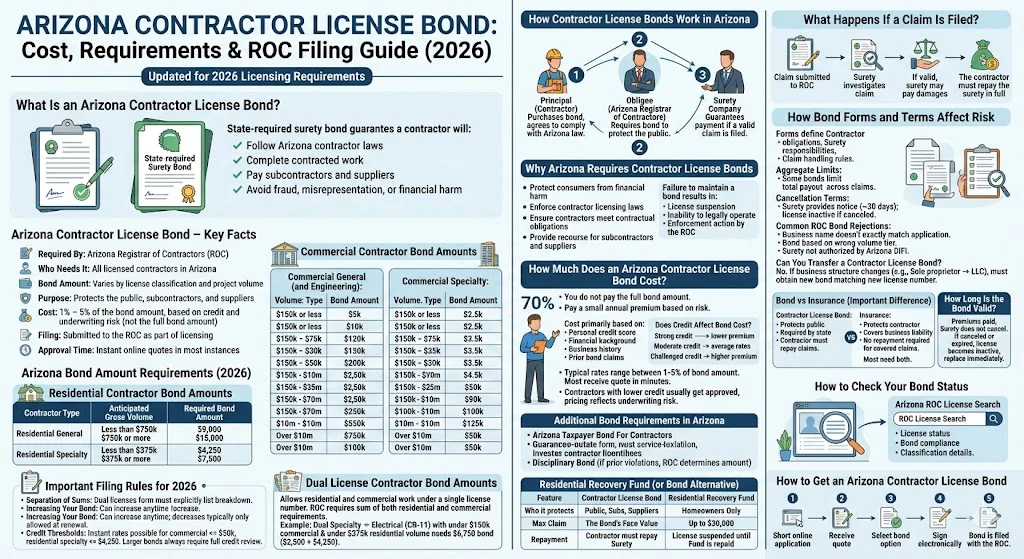
An Arizona contractor license bond is a state-required surety bond that guarantees a contractor will:
- Follow Arizona contractor laws
- Complete contracted work
- Pay subcontractors and suppliers
- Avoid fraud, misrepresentation, or financial harm
If a contractor fails to meet these obligations, a claim can be filed against the bond through the ROC.
Arizona Contractor Bond Amount Requirements
Arizona contractor license bond amounts are set by the Arizona Registrar of Contractors based on license classification, type of work, and anticipated annual volume.
Residential, commercial, and dual license contractors each have different bond requirements, and higher volume contractors are typically required to carry higher bond amounts.
Before you can estimate your cost, you need to know your required bond amount—here’s how the ROC determines it based on your license type and projected volume. Arizona Contractor Bond Amount Requirements (ROC Guide)
How Contractor License Bonds Work in Arizona
A contractor license bond is a three-party agreement:
1. Principal (Contractor)
The contractor purchases the bond and agrees to comply with Arizona law.
2. Obligee (Arizona Registrar of Contractors)
The ROC requires the bond to protect the public.
3. Surety Company
The surety guarantees payment if a valid claim is filed.
What Happens If a Claim Is Filed?
- A claim is submitted to the ROC
- The surety investigates the claim
- If valid, the surety may pay damages
- The contractor must repay the surety in full
This is a key difference from insurance.
If a claim is filed against your bond, the process moves quickly—and the financial responsibility ultimately falls on you. Arizona Contractor Bond Claims Explained: How Claims Work and How to Avoid Costly Mistakes
Why Arizona Requires Contractor License Bonds
Arizona requires license bonds to:
- Protect consumers from financial harm
- Enforce contractor licensing laws
- Ensure contractors meet contractual obligations
- Provide recourse for subcontractors and suppliers
Failure to maintain a bond can result in:
- License suspension
- Inability to legally operate
- Enforcement action by the ROC
Arizona actively investigates complaints involving unlicensed or non-compliant contractors.
Before renewing your bond, it’s important to understand why Arizona requires it and what’s at risk if you don’t maintain continuous coverage. How to Renew an Arizona Contractor License Bond
Bond vs Insurance (Important Differences)
| Feature | Contractor License Bond | Insurance |
|---|---|---|
| Who It Protects | Protects the public | Protects the contractor |
| Purpose | Required by the state for license compliance | Covers business liability and covered losses |
| Claim Repayment | Contractor must repay claims paid by the surety | No repayment required for covered claims |
Most contractors need both in practice. See our guide: Arizona ROC Contractor Insurance: What You Need for Your License
Common ROC Bond Rejections
-
Business name on bond doesn’t exactly match the ROC application.
-
Bond amount is based on the wrong projected volume tier.
-
The bond was issued by a surety not authorized by the Arizona DIFI.
How Much Does an Arizona Contractor License Bond Cost?
Arizona contractor license bond cost depends primarily on your credit profile and overall underwriting risk. Contractors do not pay the full bond amount. Instead, you pay a small annual premium based on a percentage of the required bond.
Understanding how bond pricing works starts with credit—here’s how your credit score directly impacts your cost and approval. Arizona Contractor Bond Credit Score Requirements
Most contractors pay between 1% and 5% of the bond amount per year, with exact pricing based on factors such as credit score, financial background, business history, and prior bond claims. Bond amounts vary depending on your license classification and projected annual volume as determined by the Arizona Registrar of Contractors (ROC), which directly impacts your total premium.
For detailed pricing examples, credit tiers, and real cost breakdowns: How Much Does an Arizona Contractor License Bond Cost?
Most contractors can receive a quote in minutes.

How Long Is the Bond Valid?
A contractor license bond remains active as long as:
- Premium is paid
- Surety does not cancel
If canceled or expired:
- License becomes inactive
- Contractor must file a replacement bond
Bond premiums may change at renewal based on credit and risk factors.
Additional Bond Requirements in Arizona
Depending on your situation, the ROC may require additional bonds:
Arizona Taxpayer Bond For Contractors
Disciplinary Bond
If a contractor has prior violations:
- ROC may require a disciplinary bond
- Amount determined by the ROC
- Separate from standard license bond
Residential Recovery Fund (or Bond Alternative)
Residential contractors must either:
- Pay into the Residential Recovery Fund, or
- File a separate recovery fund bond
This protects homeowners from financial loss caused by contractors.
| Feature | Contractor License Bond | Residential Recovery Fund |
|---|---|---|
| Who It Protects | Public, subs, suppliers | Homeowners only |
| Max Claim | The bond’s face value | Up to $30,000 |
| Repayment | Contractor must repay surety | License suspended until fund is repaid |
How to Get an Arizona Contractor License Bond
The process is simple:
- Complete a short online application
- Receive a quote based on your license classification
- Select your bond option
- Sign electronically
- Bond is filed with the ROC
Most contractors are approved quickly with minimal documentation.
Get a Arizona Bond Quote Now →
Frequently Asked Questions About Arizona Contractor License Bonds
Who is required to carry an Arizona contractor license bond?
The Arizona Registrar of Contractors (ROC) requires all licensed contractors and license applicants to maintain a contractor license bond as a condition of holding an active license.
Before you apply, it’s important to know who actually needs a bond—here’s who the ROC requires to carry one. How to Get an Arizona Contractor License Bond as a New Applicant
How much does an Arizona contractor license bond cost?
Most Arizona contractor license bond premiums range from 1% to 5% of the required bond amount, depending on credit, financial background, business history, and prior bond claims.
How are Arizona contractor bond amounts determined?
Bond amounts are set by the Arizona Registrar of Contractors based on license classification, type of work, and anticipated annual volume. Requirements differ for residential, commercial, and dual license contractors.
What are the Arizona residential contractor bond amounts for 2026?
Residential General contractors need a $9,000 bond if anticipated gross volume is less than $750,000 and a $15,000 bond if it is $750,000 or more. Residential Specialty contractors need a $4,250 bond if anticipated gross volume is less than $375,000 and a $7,500 bond if it is $375,000 or more.
What are the Arizona commercial contractor bond amounts for 2026?
Commercial bond amounts vary by license type and annual volume. Commercial General and Engineering classifications range from $5,000 to $100,000. Commercial Specialty classifications range from $2,500 to $50,000.
How are dual license contractor bond amounts calculated in Arizona?
For dual license contractors, the ROC generally requires a bond equal to the sum of both the residential and commercial bond requirements based on projected volume.
Does credit affect Arizona contractor bond pricing?
Yes. Credit is one of the primary pricing factors. Strong credit generally qualifies for lower premiums, while challenged credit usually results in higher rates.
Can an Arizona contractor license bond be transferred to a new business entity?
No. Arizona contractor license bonds are not transferable between business entities. If the business structure changes, such as from a sole proprietorship to an LLC, a new bond must be issued to match the new license and entity.
What happens if an Arizona contractor bond is canceled or expires?
If the bond is canceled or expires, the contractor’s license may become inactive. A replacement bond must be filed to restore the license to good standing.
If your bond lapses, your license can be affected immediately—here’s exactly what happens and how to fix it fast. What Happens If Your Arizona Contractor Bond Cancels?
What is the difference between a contractor license bond and insurance?
A contractor license bond protects the public, subcontractors, and suppliers, while insurance protects the contractor. If a bond claim is paid, the contractor must repay the surety. Covered insurance claims generally do not require repayment by the insured.
Are there additional bond requirements for Arizona contractors?
Yes. Depending on the contractor’s classification and history, the ROC may require additional bonds such as a Residential Recovery Fund bond alternative, a disciplinary bond, or an Arizona taxpayer bond for contractors.
How do contractors check their Arizona bond and license status?
Contractors can verify bond and license status using the Arizona ROC License Search tool, which shows license status, bond compliance, and classification details.
Reviewed by: Jeremy Schaedler
Principal – Surety First Insurance Services
As principal at Surety First, Jeremy Schaedler has specialized in contractor license bonds and construction insurance since 2006. CA License: 0f06277
This information is for general informational purposes only and does not constitute legal advice. Licensing and insurance requirements may change. Contractors should verify current requirements directly with their state regulatory agency or consult qualified legal counsel.

Why Contractors Choose Surety First
- Specializing in contractor bonds and insurance since 2006 (20,000+ served)
- A-rated surety markets
- Fast approvals, often within minutes
- Direct state filing
- Serving contractors across CA, OR, WA, NV, AZ
Phone: 1-800-682-1552
Website: suretyfirst.com
Sources