
 Fast, Free and No Risk



What Is a California Contractor License Bond? (2026 Complete Guide)
 Updated for 2026 California Contractor Licensing Requirements
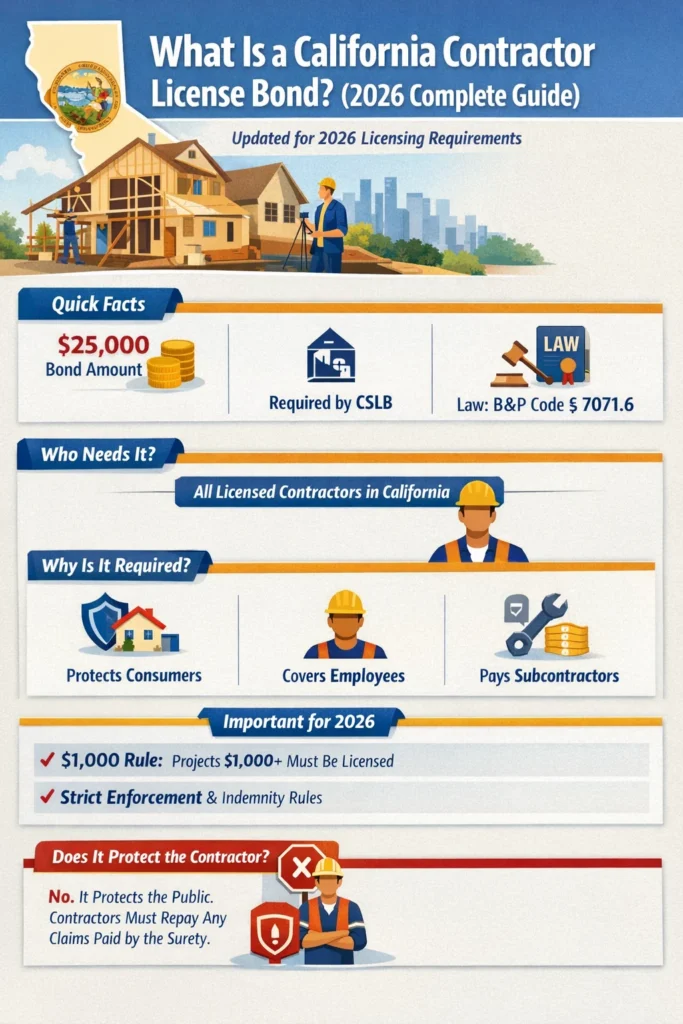
Quick Answer: A California contractor license bond is a $25,000 financial guarantee required by the Contractors State License Board (CSLB). Under Business & Professions Code §7071.6, this bond is a mandatory condition for maintaining an active license. It ensures that if a contractor violates state licensing laws, there is a dedicated fund available to compensate harmed parties.
This guide is designed for California contractors and applicants who need to understand the purpose, requirements, and legal role of the contractor license bond.
California Contractor Bond Requirements, Cost, and CSLB Filing Guide
California Contractor License Bond – 2026 Key Updates
- Bond Amount: $25,000 (state-mandated)
- Required By: California Contractors State License Board (CSLB)
- Legal Authority: California Business & Professions Code §7071.6
- Who Needs It: Licensed contractors. Unlicensed threshold is $1,000 per project enforced for licensed work (labor + materials)
- Enforcement Trend: Increased scrutiny on wage violations and unpaid subcontractors
- Surety Market: Stricter underwriting and indemnity enforcement in 2026
- Bond Cost: See How Much Does a California Contractor License Bond Cost?
▶ View Transcript
[00:00] If you’re a California contractor, you cannot legally work without one key requirement: a contractor license bond.
[00:07] A California contractor license bond is a $25,000 financial guarantee required by the CSLB to keep your license active.
[00:16] It ensures contractors follow California licensing laws and provides financial protection if those laws are violated.
[00:25] The bond protects homeowners, employees, and subcontractors, not the contractor’s business.
[00:34] This is not insurance. If a valid claim is paid, the contractor must repay the surety in full.
[00:43] In 2026, stricter enforcement and the $1,000 project threshold make compliance even more important.
[00:52] Bottom line: the contractor license bond is your ticket to legally operate in California.
[00:59] No bond, no active license.
What the Contractor License Bond Actually Is
It is a commercial surety bond that acts as a financial guarantee that California contractors obey all state and local laws required to:
- Obtain a contractor license
- Maintain an active license
The bond is not “protection” for your business; it is a consumer protection tool. Per BPC §7071.5, the bond is held for the benefit of:
-
Homeowners: For damages resulting from a violation of the construction contract.
-
Employees: For non-payment of wages or fringe benefits.
-
Subcontractors/Suppliers: For failure to pay for labor or materials provided to a project.
What the Bond Protects
The bond protects:
- Consumers
- Employees
- Subcontractors
If a contractor violates the law, a claim may be filed.
CSLB Bond Claim: How to Handle, Defend & Reinstate Your License
The “Indemnity” Factor: Why It’s Not Insurance
The most critical distinction for any contractor is the Indemnity Agreement. In 2026, sureties are strictly enforcing these contracts.
Crucial Difference: When an insurance company pays a claim, they take the loss. When a Surety pays a bond claim, they look to you for reimbursement. You are legally required to pay back every penny the surety spends on your behalf, including legal fees.
To learn more about protection for your business, see our contractors general liability insurance guide here:
Contractor General Liability Insurance: Cost, Coverage & Requirements (2026 Guide)
What the Bond Does NOT Cover
The bond does NOT:
- Protect the contractor
- Replace insurance
- Cover business losses
Have questions about who is required to have a contractor’s bond in California? See our guide:
Who Needs a Contractor License Bond in California? (CSLB Requirements Explained)
Legal Requirement
- A contractors license bond is required under California Business & Professions Code §7071.6, however, not all construction work requires a contractors license in California.
How Does a California Contractor License Bond Work? (Simple Explanation)
2026 Legal Requirements & Thresholds
-
The $1,000 Rule: As of 2026, the threshold for unlicensed work was updated. Any project totaling $1,000 or more (labor + materials) now legally requires a license and, by extension, an active bond.
Why the Bond Exists
The bond exists to protect consumers and make sure contractors operate in a fair and ethical manner. It ensures:
- Legal compliance
- Financial responsibility
- Consumer protection
Get a CA Contractor Bond Quote →
Key Takeaway for 2026
The contractor license bond is your “ticket to play.” Without it, the CSLB cannot issue or renew your pocket card. In an era of rising inflation and stricter wage theft penalties, your bond is the CSLB’s primary tool for ensuring you are a financially responsible professional.
Frequently Asked Questions (FAQ)
What is a California contractor license bond?
A $25,000 surety bond required by the CSLB that guarantees a contractor will comply with California licensing laws.
Is a contractor license bond required in California?
Yes. It is required to obtain and maintain an active contractor license under California law.
What is the purpose of a contractor license bond?
To protect consumers, employees, and subcontractors if a contractor violates licensing laws or financial obligations.
Does a contractor license bond protect the contractor?
No. It protects the public, and the contractor must repay the surety for any paid claims.
Is a contractor license bond the same as insurance?
No. A bond guarantees compliance, while insurance protects the contractor from losses.
What is the required bond amount in California?
The required amount is $25,000.
Related California Contractor Bond Guides
-
- California Contractor Bond Requirements, Cost, and CSLB Filing Guide
- How to Get a California Contractor License Bond as a New Applicant
- How to Get a CSLB License Bond with Bad Credit
- CSLB Bond Lapses: How to Fix an Automatic License Suspension
- Renewing Your California Contractor License Bond: Multi-Year vs. Annual Terms
- Bond of Qualifying Individual (BQI): Requirements, Cost, and CSLB Filing Guide (2026)
- California LLC Employee/Worker Bond – Cost, Requirements & CSLB Filing Guide (2026)
Reviewed by: Jeremy Schaedler
Principal – Surety First Insurance Services
As principal at Surety First, Jeremy Schaedler has specialized in contractor license bonds and construction insurance since 2006. CA License: 0f06277
This information is for general informational purposes only and does not constitute legal advice. Licensing and insurance requirements may change. Contractors should verify current requirements directly with their state regulatory agency or consult qualified legal counsel.

Why Contractors Choose Surety First
- Specializing in contractor bonds and insurance since 2006 (20,000+ served)
- A-rated surety markets
- Fast approvals, often within minutes
- Electronic CSLB filing
- Serving contractors across CA, OR, WA, NV, AZ
Phone: 1-800-682-1552
Website: suretyfirst.com
Official Regulatory & Legal References:
-
California Business & Professions Code § 7071.6 (Contractor’s Bond Requirement): The statutory mandate requiring every active contractor license to maintain a valid surety bond on file. Source: California Legislative Information – BPC § 7071.6
-
California Business & Professions Code § 7071.5 (Beneficiaries of Bond): The law defining who is protected by the contractor license bond, specifically homeowners, employees, and subcontractors. Source: California Legislative Information – BPC § 7071.5
-
CSLB – Contractor Bond Information: The official Contractors State License Board overview explaining bond amounts, requirements, and electronic filing. Source: Contractors State License Board (CSLB) – About Contractor Bonds
-
California Department of Insurance – Company Search: Official state tool to verify that a surety company is admitted and authorized to issue bonds in California. Source: California Department of Insurance
-
California Business & Professions Code § 7028 (Unlicensed Activity): The legal definition of unlicensed contracting, establishing the $1,000 threshold and licensure requirements. Source: California Legislative Information – BPC § 7028
- View California Business & Professions Code §7048 Current threshold: $1,000 total job value