
 Fast, Free and No Risk



California Disciplinary Bonds: The Expert Guide to Reinstating a Revoked CSLB License

Updated for 2026 CSLB Disciplinary Requirements
Quick Answer: A California disciplinary bond is a higher-risk surety bond required by the California Contractors State License Board (CSLB) after serious violations, license revocation, or disciplinary action.
These bonds are typically required before a contractor can reinstate or maintain an active license following a compliance issue. Bond amounts can be significantly higher than the standard $25,000 contractor license bond and reflect increased regulatory risk.
California Contractor Bond Requirements, Cost, and CSLB Filing Guide (2026)
California Disciplinary Bond – Key Facts
- Bond Type: California CSLB disciplinary bond
- Required Under: Business and Professions Code § 7071.8
- Who Requires It: California Contractors State License Board (CSLB)
- Who It Applies To: Contractors with revoked, suspended, or probationary licenses
- Minimum Bond Amount: $25,000
- Maximum Bond Amount: Up to $250,000
- How Amount Is Set: Determined by the CSLB Registrar based on violation severity
- Separate from Standard Bond: Yes, it is in addition to the contractor license bond
- Can It Replace the Standard Bond? No
- Typical Filing Requirement: Required for license reinstatement, reissuance, or probation compliance
- Minimum Time on File: Typically at least 2 years
- Longer Filing Period Possible: Yes, depending on CSLB order
- Main Purpose: Protect the public after serious contractor violations
- Other Requirements: May include application, exams, and proof of satisfied losses or disciplinary conditions
- Underwriting Difficulty: Higher risk than standard contractor bonds
- Main Underwriting Factors: Violation history, financial condition, claims, and indemnity strength
What Is a California Disciplinary Bond?
A disciplinary bond is not the same as the normal CSLB contractor license bond. It is a higher-risk bond required after disciplinary action under Business and Professions Code section 7071.8. CSLB states that if a license has been revoked for a violation of the Contractors’ License Law, the company must file a disciplinary bond with the Registrar in order to reinstate or reissue the license. CSLB also explains that, in some suspension situations, a disciplinary bond may be required before the license will be reinstated or reissued, and during some probationary stays it may be required for the contractor to remain in business.
▶ View Video Transcript
[00:00] If your California contractor license has been revoked, you may need a disciplinary bond to get back in business.
[00:08] A disciplinary bond is a special surety bond required by the CSLB after serious violations and is used to reinstate or reissue a contractor license.
[00:18] The required bond amount can range from $25,000 up to $250,000, depending on the severity of the violation.
[00:28] Because this is a high-risk bond, pricing is usually much higher than a standard contractor bond and depends on your financial profile and prior issues.
[00:40] The process is straightforward: apply, complete underwriting review, get approved, and file the bond with the CSLB.
[00:51] Once approved and filed, you can move forward with reinstating your license and getting back to work.
[00:58] Get a disciplinary bond quote today and restore your license as quickly as possible.
Who Needs a CSLB Disciplinary Bond?
You may need a disciplinary bond if:
- Your California contractor license was revoked for a violation of the Contractors’ State License Law.
- Your license is under a suspension or probationary order that requires a disciplinary bond.
- You are trying to reinstate, reissue, or reapply for licensure after disciplinary action.
This is one of the biggest points contractors misunderstand: a disciplinary bond is not a routine bond for ordinary licensing. It is a special requirement triggered by CSLB discipline.

How Is a California Disciplinary Bond Amount Determined?
The Registrar determines the bond amount. CSLB states that the amount:
- Cannot be less than $25,000
- Cannot be greater than 10 times the contractor license bond
Because the standard California contractor license bond is currently $25,000, the maximum disciplinary bond can be $250,000. CSLB also states the amount is based on the seriousness of the violation.
Example: A contractor required to file a $100,000 disciplinary bond after a license suspension may pay a significantly higher premium due to prior violations and underwriting risk.
Disciplinary Bond Amounts at a Glance
| Requirement | Amount |
|---|---|
| Minimum disciplinary bond | $25,000 |
| Maximum disciplinary bond | $250,000 |
| Basis for amount | Seriousness of violation(s) |
| Separate from regular contractor bond? | Yes |
California Disciplinary Bond Cost (What to Expect)
The cost of a California disciplinary bond is significantly higher than a standard contractor license bond because it is considered a high-risk surety obligation. Unlike standard bonds, disciplinary bonds are required after license violations, which increases underwriting scrutiny and pricing.
Most contractors do not pay the full bond amount. Instead, you pay an annual premium based on risk. For disciplinary bonds, premiums are typically much higher due to prior violations, unpaid claims, or financial issues.
Typical Cost Range
- Estimated Rate: Approximately 3% to 15% of the bond amount
- Lower Risk Cases: May qualify toward the lower end of the range
- Higher Risk Cases: Can exceed standard ranges depending on severity
For example, a $75,000 disciplinary bond may cost significantly more than a standard contractor bond due to the increased risk profile, while a $150,000 or $250,000 bond will result in substantially higher premiums.
What Affects Disciplinary Bond Cost
- Severity of CSLB violation: More serious violations result in higher bond amounts and premiums
- Bond amount required: Set by the CSLB Registrar (up to $250,000)
- Credit profile: Lower credit increases perceived risk
- Unpaid claims or judgments: Major factor in underwriting decisions
- Financial stability: Stronger financials may improve approval and pricing
- Indemnity strength: Personal or business guarantees impact approval
Important Cost Considerations
- High-risk classification: Disciplinary bonds are among the hardest bonds to underwrite
- Limited markets: Fewer surety companies offer these bonds
- Possible collateral: Some cases may require additional security
- Multi-year requirement: Bond must typically remain active for at least 2 years
Because disciplinary bonds are tied directly to prior CSLB violations, pricing varies widely. The most important factor is demonstrating that all disciplinary conditions have been satisfied and that the contractor presents a reduced risk going forward.
Disciplinary Bond vs. Standard Contractor License Bond
A disciplinary bond is not the same as the standard California contractor license bond.
- Standard bond: $25,000 requirement for all contractors
- Disciplinary bond: Much higher amount required after CSLB enforcement action
The disciplinary bond is imposed because the CSLB considers the contractor a higher compliance risk.
For standard bond requirements, see California Contractor License Bond Guide.
Is the Disciplinary Bond in Addition to the Regular CSLB Bond?
Yes. CSLB is explicit that the disciplinary bond must be filed in addition to any other bond required on an active contractor’s license. It cannot replace or be combined with the regular contractor bond.
That means a contractor may need:
- the standard contractor license bond
- a bond of qualifying individual, if applicable
- and the disciplinary bond required by the Registrar.
Disciplinary Bond vs Standard Contractor Bond
| Feature | Standard Bond | Disciplinary Bond |
|---|---|---|
| Amount | $25,000 | $25,000–$250,000 |
| Risk Level | Low | High |
| Required When | License issuance | After violations |
| Underwriting | Easy | Difficult |
| Purpose | Compliance | Consumer protection after discipline |
How Long Must the Bond Stay on File?
CSLB states that the disciplinary bond must remain current and on file with the Registrar for at least two years, and in some cases the Registrar may require a longer filing period. CSLB also states the company’s license must remain active and current while the disciplinary bond is on file.
Get a fast quote from high-risk surety specialists and file with the CSLB.
How to Reinstate a Revoked CSLB License
If your license was revoked, CSLB says you must generally file an Application for Original Contractors License and pass the law and trade exams if your license was revoked, suspended, or has been expired for more than five years. CSLB also requires documented evidence showing that all loss resulting from the revocation or suspension has been fully satisfied and that you complied with all terms and conditions imposed by the revocation.
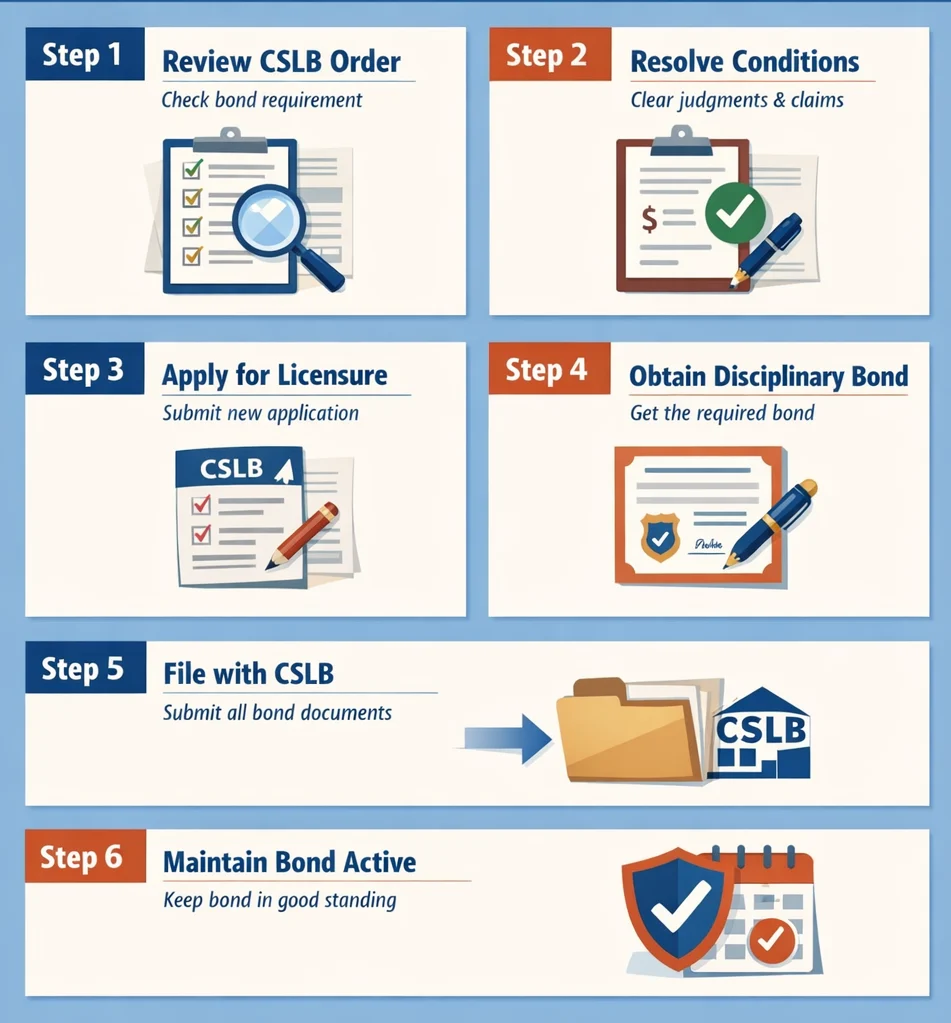
Step-by-Step Reinstatement Process
Step 1: Review the CSLB order and bond requirement
Confirm whether the Registrar is requiring a disciplinary bond, and for what amount.
Step 2: Resolve outstanding conditions
Make sure judgments, losses, restitution, or other disciplinary conditions have been satisfied, because CSLB requires documentation showing compliance.
Step 3: Apply for licensure or reinstatement
If your license was revoked, you will generally need to file an original license application with CSLB.
Step 4: Obtain the disciplinary bond
The bond must be written by a surety company licensed by the California Department of Insurance, and the business name and license number on the bond must match CSLB records exactly.
Step 5: File all required bond documents with CSLB
CSLB’s reactivation guidance states contractors must meet all bond requirements, including disciplinary bonds, and attach all required bonds to the application rather than sending them separately.
Step 6: Keep the bond active for the full required period
A lapse can create another licensing problem. The disciplinary bond must stay current for the required term.
Why Disciplinary Bonds Are Harder to Get
A disciplinary bond is a much tougher underwriting case than a standard contractor bond. The reason is simple: the contractor has already had a serious enough licensing issue that CSLB imposed a special bond requirement. Sureties view that as materially higher risk. CSLB’s own guidance ties the bond amount to the seriousness of the violation, and the bond can be far larger than the standard bond.
In practice, underwriters often look closely at:
- the underlying CSLB violation
- unpaid claims or judgments
- current financial condition
- business continuity
- indemnity strength
- whether all disciplinary conditions have been satisfied
That last point matters. Even if a surety will consider the risk, CSLB still requires proof that revocation-related losses and conditions were resolved.
Common Mistakes Contractors Make
Confusing a disciplinary bond with a regular license bond
They are not the same. The disciplinary bond is a special post-discipline requirement.
Assuming the amount is always $25,000
It is not. The Registrar sets the amount, and it can be much higher.
Thinking the bond alone reinstates the license
It does not. CSLB may require an original application, exams, and proof that all losses and conditions were satisfied.
Letting the bond lapse after reinstatement
CSLB requires the bond to remain current for at least two years, and sometimes longer.
Get a CA Contractor Bond Quote →
Frequently Asked Questions
What is the disciplinary bond amount in California?
The minimum is $25,000 and the maximum is 10 times the current contractor bond, which currently means up to $250,000. The Registrar sets the exact amount based on the seriousness of the violation.
Does a disciplinary bond replace the regular contractor bond?
No. CSLB states that the disciplinary bond must be filed in addition to other required bonds on an active license.
How long does the disciplinary bond have to stay on file?
Usually at least two years, although CSLB may require a longer period in some cases.
Can a suspended license also require a disciplinary bond?
Yes. CSLB states that depending on the type of suspension, a disciplinary bond may be required before the license will be reinstated or reissued, and some probationary stays also require one.
What else is required to reinstate a revoked CSLB license?
CSLB says revoked contractors generally must file an original application, take and pass the law and trade exams, and provide documented evidence that all loss from the revocation or suspension has been satisfied and all imposed terms were met.
Final Takeaway
A California disciplinary bond is one of the most serious bond requirements a contractor can face. It is not a routine licensing bond. It is a special bond required after disciplinary action, usually to reinstate or reissue a revoked license, and the amount can range from $25,000 to $250,000 depending on the seriousness of the violation. It must be filed in addition to the standard bond and usually must stay on file for at least two years. Contractors trying to come back from a revocation should treat this as both a licensing issue and a high-risk surety issue.
Related California Contractor Bond Guides
- California Contractor Bond Requirements, Cost, and CSLB Filing Guide (2026)
- How Much Does a California Contractor License Bond Cost?
- CSLB Bond Claim: How to Handle, Defend & Reinstate Your License (2026 Guide)
- CSLB Bond Lapses: How to Fix an Automatic License Suspension
- How Does a California Contractor License Bond Work? (Simple Explanation)
Reviewed by: Jeremy Schaedler
Principal – Surety First Insurance Services
As principal at Surety First, Jeremy Schaedler has specialized in contractor license bonds and construction insurance since 2006. CA License: 0f06277
This information is for general informational purposes only and does not constitute legal advice. Licensing and insurance requirements may change. Contractors should verify current requirements directly with their state regulatory agency or consult qualified legal counsel.

Why Contractors Choose Surety First
- Specializing in contractor bonds and insurance since 2006 (20,000+ served)
- A-rated surety markets
- Fast approvals, often within minutes
- Electronic CSLB filing
- Serving contractors across CA, OR, WA, NV, AZ
Phone: 1-800-682-1552
Website: suretyfirst.com
Sources
-
Statutory Requirement (BPC § 7071.8): California Business and Professions Code (BPC) § 7071.8 mandates the disciplinary bond for revoked, suspended, or probationary licenses. The Registrar determines the specific amount.
-
Bond Amounts (CSLB Guidance): The standard contractor license bond is verified at **$25,000**. CSLB confirmation on disciplinary bond range ($25k to $250k) can be verified on their official Bonding for Contractors resource.
-
Filing Requirements (CSLB Guidance): Directives from the CSLB’s Reactivating a License guide explicitly state that a disciplinary bond must be filed in addition to standard bonds and should be attached to the application.
-
Indemnity Obligation (BPC § 7071.11): Confirmation that a surety bond is a form of credit, not insurance, is grounded in BPC § 7071.11, which details the indemnity agreement.